Artificial intelligence is starting to change women's health in the places that matter most in day to day practice: earlier pattern detection, faster interpretation of complex data, better triage, more consistent follow up, and less clerical drag on already busy teams. The strongest systems are not trying to replace obstetricians, gynecologists, sonographers, or care teams. They are trying to make those teams faster, more informed, and more consistent when the volume of data keeps growing.
That distinction matters. Women's health is not a single workflow. It spans reproductive health, pregnancy, fetal imaging, gynecologic imaging, preventive screening, chronic condition management, patient communication, and postpartum follow up. Each of those areas has different risks, different data types, and different opportunities for AI to help. The best implementations are narrow, validated, and accountable. They support clinical judgment rather than trying to substitute for it.
For OBGYNs and women's health professionals, the most immediate value of AI is often not a futuristic diagnosis engine. It is the removal of friction. It can reduce time spent sorting records, surface important patterns in imaging or longitudinal data, improve appointment triage, and help teams respond to patients with more speed and consistency. In a field where delays can affect outcomes, that practical support is worth a serious look.
1. Where AI is already helping women's health
AI is already being explored across obstetrics and gynecology, including fetal ultrasound, gynecologic imaging, assisted reproductive medicine, and maternal risk prediction. Reviews in the field show that use of AI has expanded across OBGYN journals and that researchers are actively studying how machine learning and deep learning can support imaging, prediction, and clinical workflow.
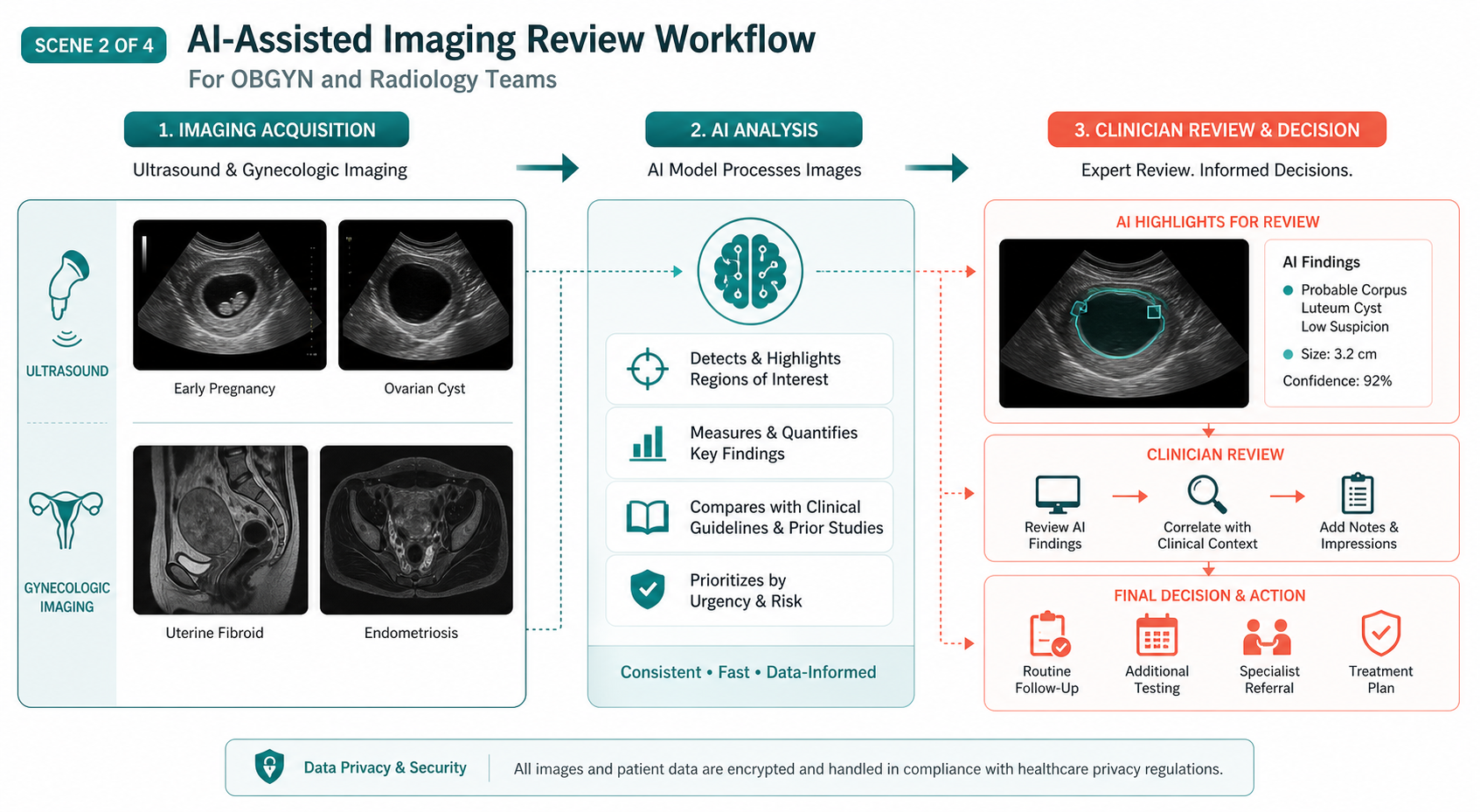
One of the clearest examples is imaging. In gynecology, AI can help with segmentation, detection, classification, and triage on ultrasound and radiology studies. That does not mean the machine makes the final call. It means it can help the clinician see faster, compare more consistently, and focus on the cases that need closer attention. In maternal care, AI is also being studied for fetal ultrasound interpretation, cardiotocography support, and prediction of pregnancy related complications such as preeclampsia, preterm birth, and gestational diabetes.
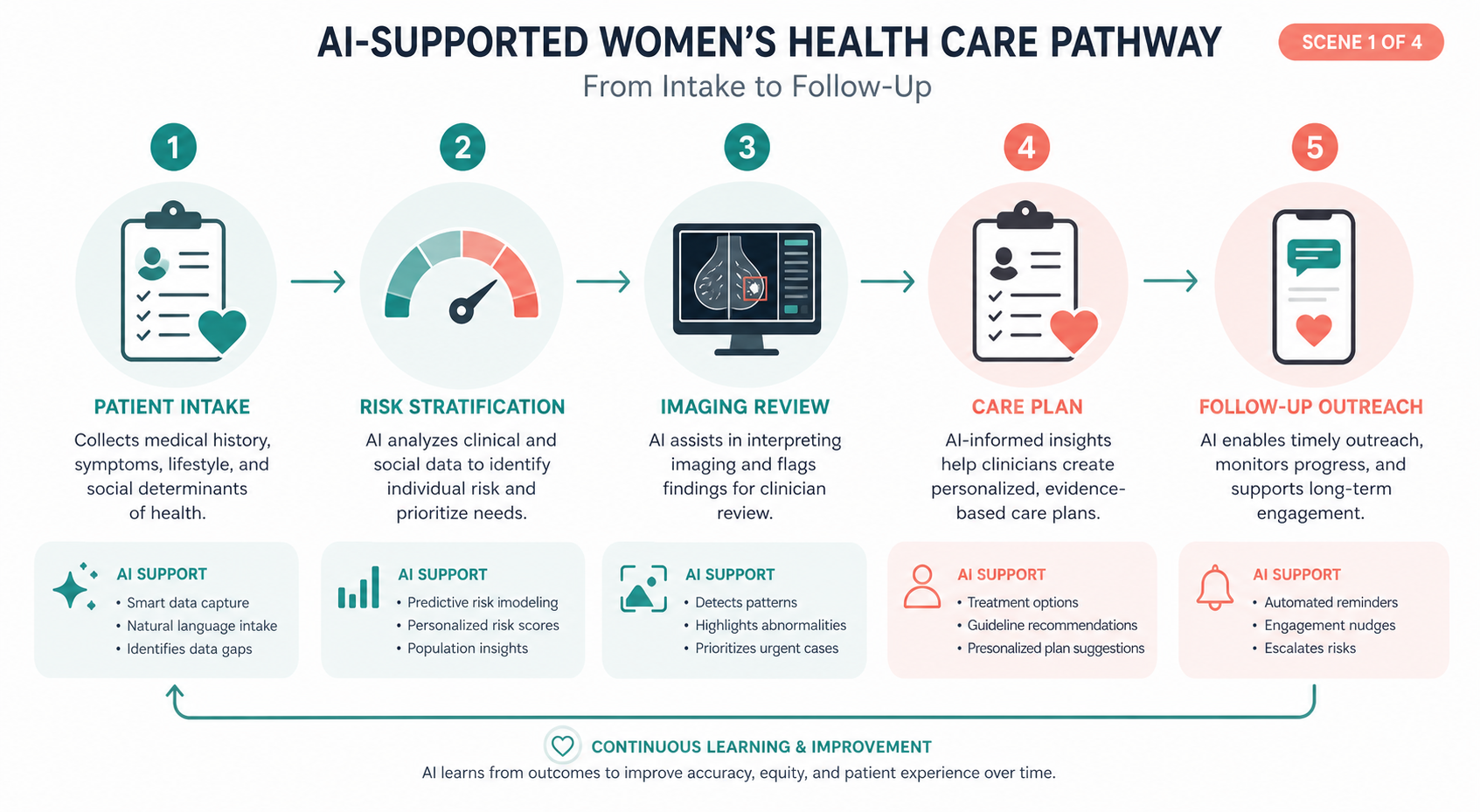
That full path view is important because women's health outcomes often depend on what happens between visits. Missed follow up, incomplete screening histories, delayed communication, and administrative delays can all erode care quality. AI can help by making it easier to identify who needs outreach, which records need review, and where a practice is losing time.
2. Imaging and interpretation: faster, more consistent support
Fetal ultrasound and gynecologic imaging are two of the most promising areas for AI support. In fetal imaging, deep learning methods have been studied for view classification, structure detection, and image quality support. In gynecologic imaging, AI is being used to analyze ultrasound data for both benign and malignant conditions, helping identify patterns that may not be obvious at first glance.
For clinicians, the real value is not novelty. It is consistency. Human interpretation is excellent, but it is still affected by time pressure, fatigue, and variation in experience. AI can act like a second set of eyes that never gets tired. It can flag images that deserve a closer review, help normalize measurements, and reduce variation between readers.
That matters in a practice where many images are reviewed every day and where small differences in timing or interpretation can alter patient anxiety, follow up plans, or referral decisions. AI should not be treated as an oracle. It should be treated as a controlled support layer that improves the reliability of the workflow.
3. Maternal health: earlier risk awareness and better coordination
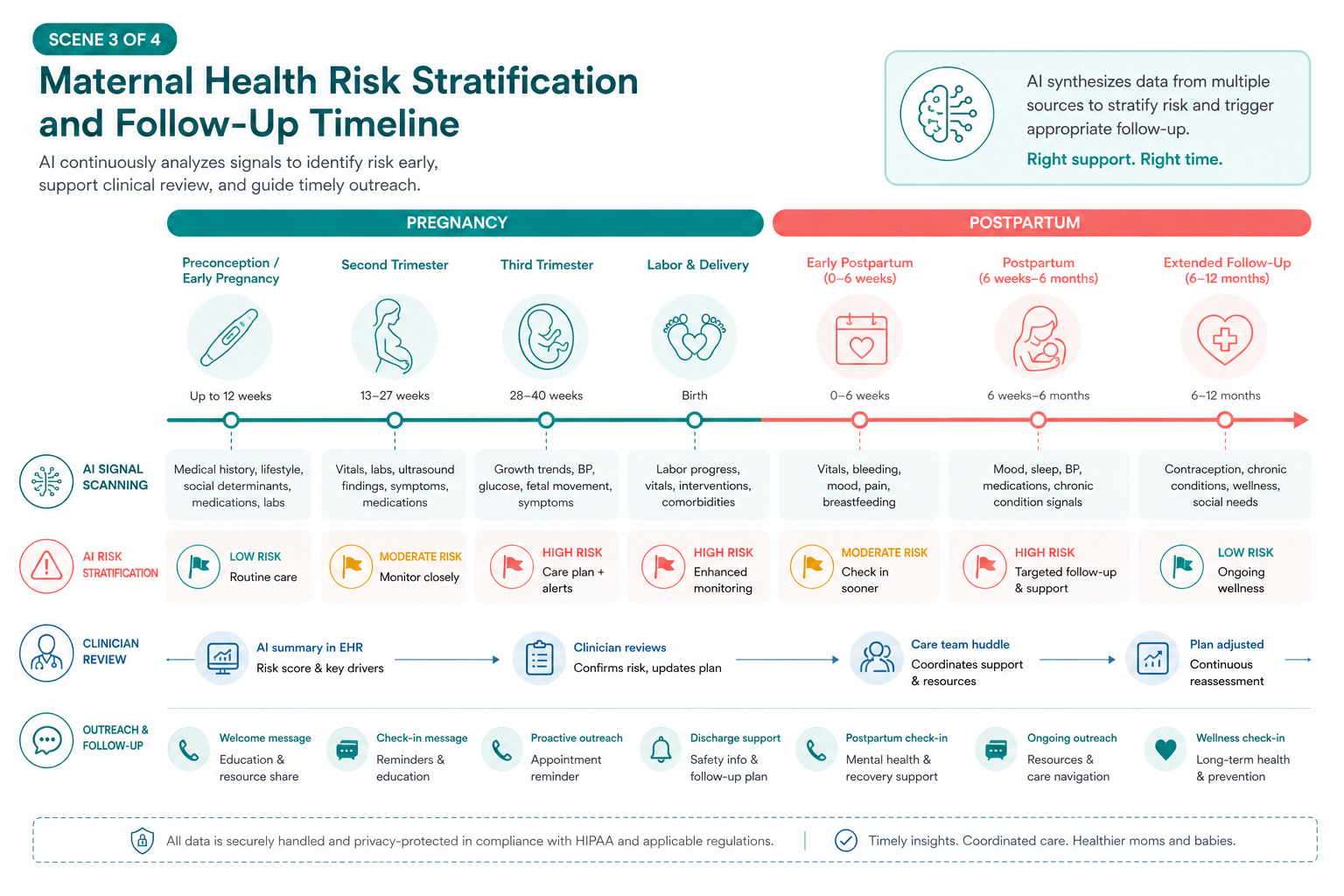
Maternal health is another area where AI is showing real potential. Global health bodies emphasize that maternal health is not only about preventing death. It is also about reducing morbidity, disability, and avoidable complications that affect a woman's long term wellbeing. That broader view makes AI especially interesting, because it can help detect patterns across time rather than just isolate a single event.
Risk prediction models can help practices identify patients who may need more attention during pregnancy or postpartum follow up. When built responsibly, these tools can support earlier intervention for conditions such as preeclampsia risk, gestational diabetes monitoring, preterm birth risk, and postpartum care gaps. AI enabled communication tools can also help teams keep track of follow up tasks, reminders, and symptom check ins.
The practical benefit is coordination. A clinic can only manage what it can see. If AI helps surface the patient who missed a labs review, the postpartum patient who has not responded to outreach, or the pregnancy complication that is becoming more likely based on the pattern of prior data, the care team can act sooner.
4. Preventive women's health: screening, continuity, and outreach
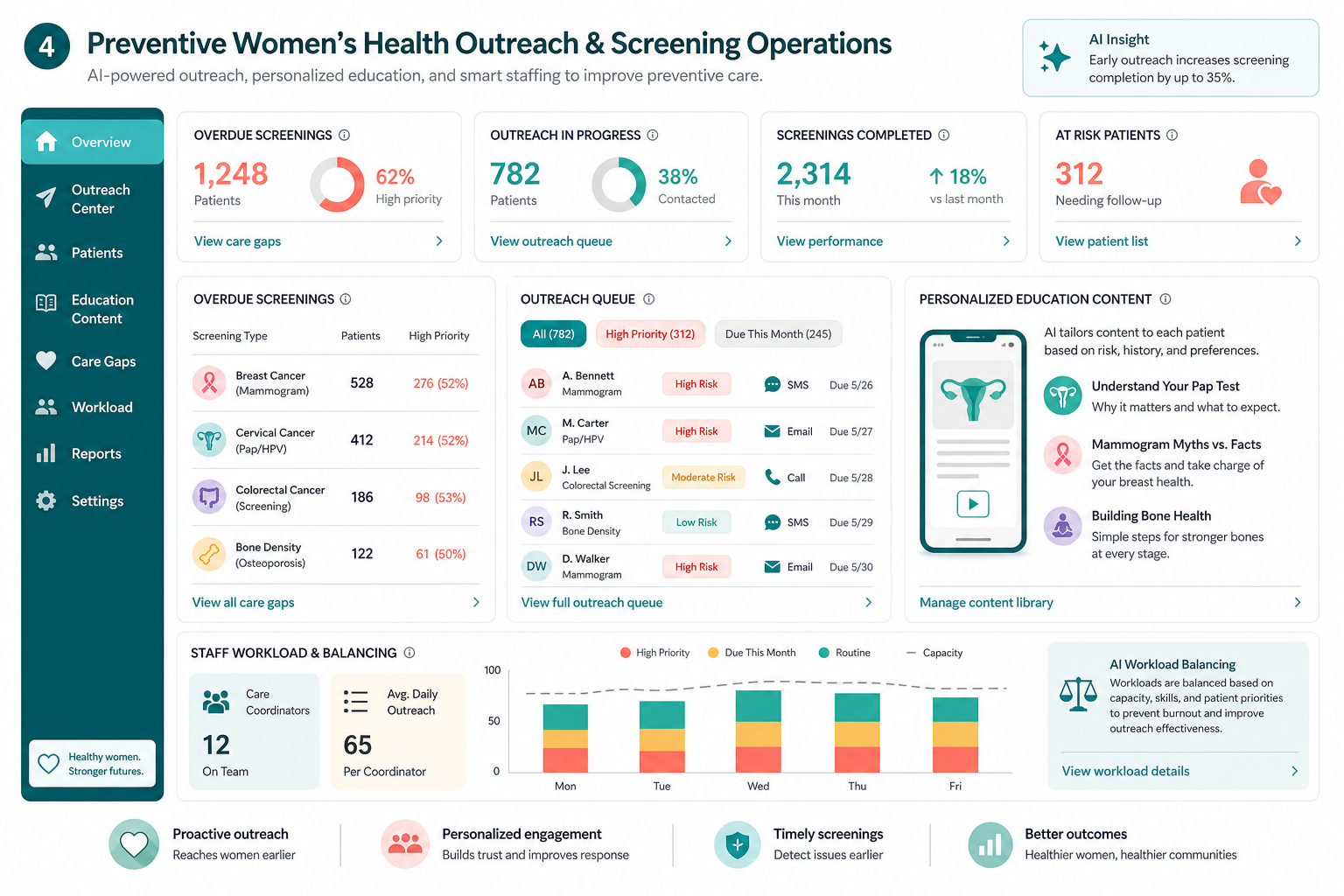
Women's health is full of preventive workflows that depend on continuity. Breast screening, cervical cancer prevention, fertility counseling, chronic condition monitoring, and general preventive care all rely on getting the right patient the right reminder at the right time. AI can improve those systems without changing the clinical standard of care.
In practice, that often means better population health operations. AI can sort records by risk, identify overdue screening, flag incomplete histories, and help care teams target outreach more effectively. In a busy OBGYN or women's health practice, that can have a direct effect on patient safety and revenue integrity. Fewer missed screenings and cleaner follow up workflows improve both clinical quality and operational efficiency.
AI also helps with personalization. Women's health education is most effective when it is tailored to the patient's language, literacy level, stage of care, and clinical context. AI assisted content generation, when carefully reviewed by clinicians and staff, can help practices produce patient instructions, follow up summaries, and FAQ material more quickly.
5. What good AI looks like in women's health
Not every AI system belongs in clinical practice. A useful AI solution in women's health should be clinically validated for the intended use case, transparent about what it can and cannot do, audited for bias and performance drift, integrated into existing workflow instead of creating a second workflow, and supervised by humans who remain responsible for the decision.
That last point is critical. Women's health care depends on trust, and trust depends on accountability. If an AI system quietly changes behavior, offers unsupported recommendations, or amplifies bias, it can do more harm than good. Responsible adoption means asking hard questions about data quality, model performance across populations, governance, and escalation pathways.
AI can improve delivery and outcomes, but only if ethical considerations, training, validation, and evaluation are built into the process. For women's health, that means considering diversity in training data, clinical supervision, and a clear policy for when the model should be ignored.
6. Where ITSulu fits in
This is where ITSulu AI services become useful. Most healthcare organizations do not need a flashy AI demo. They need a practical, governed system that works with their existing operations.
ITSulu can help women's health organizations with AI strategy for clinical and operational use cases, workflow design for intake, follow up, and outreach, content automation for patient education and internal communication, data integration between websites, CRM, scheduling, and reporting systems, governance and validation so AI use is accountable and auditable, and implementation support for teams that need the system to fit real clinic operations.
In other words, ITSulu helps connect the front door, the clinical workflow, and the follow up layer. That might mean reducing administrative burden, improving patient communication, surfacing overdue tasks, or organizing the data that a clinical team already has but cannot easily use.
For OBGYN and women's health leaders, that kind of support is often the difference between we looked at AI and we actually improved care operations.
7. The right question is not whether to use AI
The better question is where AI can reduce friction without creating risk.
In women's health, AI is most valuable when it helps teams see patterns earlier, coordinate care more reliably, reduce administrative burden, and communicate clearly with patients. That is a meaningful role. It is also a realistic one. The goal is not to automate empathy or clinical judgment. The goal is to give clinicians more time, more visibility, and more consistency so they can use their expertise where it matters most.
For practices that want to modernize without losing control, that is the right place to start.
How ITSulu Can Help
ITSulu helps healthcare teams turn AI from a vague idea into a working operating model. For women's health organizations, that can include workflow mapping, content automation, data integration, patient communication design, and governance for responsible AI use.
If your practice wants to explore AI in a way that is practical, clinically aware, and operationally useful, ITSulu can help design the right path from the first workflow review to the live implementation.