The ERP software market hits $175.9 billion in 2026, Odoo is rolling out AI copilots that let users update records via chat, and pricing changes are forcing upgrade decisions across thousands of businesses. Here’s what IT leaders need to know this morning.
Odoo AI Copilot: Update Records, Generate Images, Build Websites by Chat
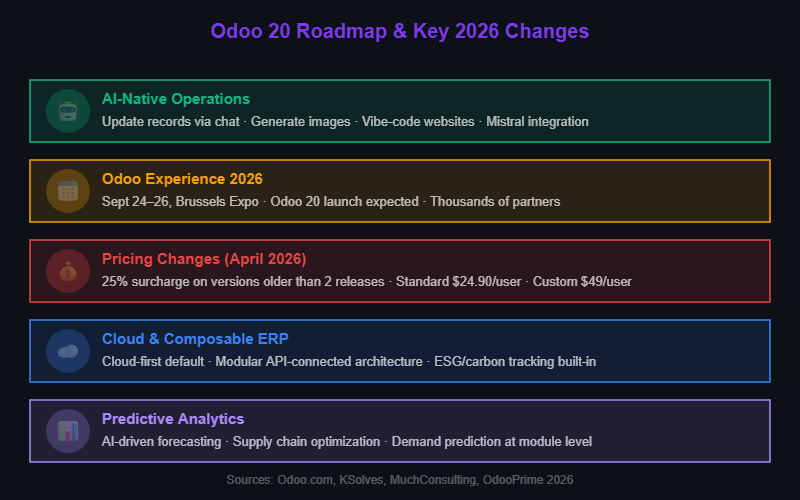
Odoo’s latest releases (19.1 through 19.3) have turned the AI copilot from a novelty into a core operational interface. Users can now update records with natural language instructions, “move this deal to negotiation and set follow-up for Friday”, without touching a form field. The system can create new records like customer profiles, generate product images on demand, and build entire website sections from plain-language descriptions (what Odoo is calling “Vibe code”). AI agents can also look up information online to answer questions directly inside workflow contexts.
The model roster is expanding too. Odoo currently integrates ChatGPT and Gemini, with Mistral being fast tracked for European clients given data sovereignty requirements. This signals Odoo’s intent: AI isn’t a bolt-on module, it’s becoming the primary interface layer sitting on top of every existing workflow.
For IT leaders evaluating ERP upgrades: the practical question isn’t whether AI copilots are useful in demos. It’s whether your current version supports them. Odoo 20 is expected to make AI a fully independent operational layer. Organizations still running Odoo 14 or 15 are looking at a two-generation capability gap.
ERP Market Hits $175.9 Billion — And M&A Is Accelerating
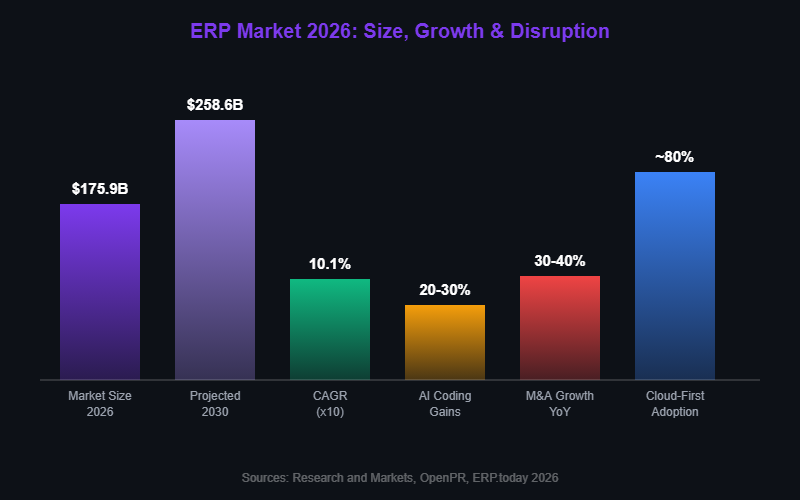
The global ERP software market is valued at $175.9 billion in 2026, on a path to $258.6 billion by 2030 at a 10.1% CAGR. That headline number understates the disruption: M&A activity in enterprise software has surged 30–40% year-over-year to an estimated $600 billion in 2026, as AI capabilities become the primary acquisition target rather than customer base or revenue.
The strategic implication for businesses: the ERP vendor landscape is consolidating faster than at any point in the last decade. Mid-market vendors without credible AI roadmaps are being absorbed or displaced. For organizations mid-implementation or approaching contract renewal, vendor stability is no longer a given — it needs to be evaluated explicitly alongside feature roadmaps and pricing.
Odoo occupies an interesting position in this landscape. As an open-source platform with over 12 million users and a community-plus-enterprise model, it sits outside the primary M&A consolidation wave while benefiting from the same AI infrastructure investments. The $24.90/user Standard plan remains one of the most competitive price points in the market for SME deployments.
Odoo Pricing Changes Force Upgrade Decisions Now
Starting April 2026, Odoo applies a 25% pricing surcharge to any database running a version older than the two most recent major releases. Combined with rate increases of up to 30% over 2025 pricing (Standard plan now $24.90/user, Custom plan $49/user for US/Canada), this creates a compounding cost pressure for organizations that have deferred upgrades.
The math is straightforward: an organization running 50 users on an older version now faces both the surcharge and the base rate increase simultaneously. Deferring another year doesn’t reduce that pressure — Odoo 20 is expected at Odoo Experience in September 2026, which will push more installations outside the two-release window.
Odoo Experience 2026 is scheduled for September 24–26 at Brussels Expo — a three-day flagship event expected to formally preview Odoo 20. For partners and large enterprise customers, this is the decision point: plan migrations before the event to avoid post-launch implementation queues.
What Executives Should Do
- Audit your Odoo version against the two-release policy. If you’re running anything older than Odoo 17, the 25% surcharge is already costing you. Calculate the annual delta and use it to build the upgrade business case.
- Evaluate AI copilot capability gaps now, not at renewal. The gap between Odoo 14/15 and 19/20 AI capabilities is architectural. Build that delta into your competitive risk assessment.
- Start upgrade planning before Odoo Experience (September 2026). Post-event partner availability will be compressed. Organizations that engage implementation partners in June–July will have significantly more scheduling flexibility.
- Re-evaluate vendor stability across your ERP stack. With $600B in enterprise software M&A underway, your secondary ERP vendors may be mid-acquisition. Verify continuity commitments in current contracts.
- Pilot composable ERP architecture for new module additions. Use API-connected modules for new functional areas rather than extending a monolithic installation. This reduces upgrade risk and improves portability.
The ITSulu Perspective
ITSulu’s Odoo consultation practice works with organizations at exactly the inflection point this market is creating: still getting value from an older installation, but facing compounding costs and widening capability gaps. The upgrade decision isn’t just technical, it’s a business case that weighs the surcharge math, the AI capability delta, and the implementation window before September. We help clients build that case, plan the migration, and deploy AI native workflows that weren’t possible in their previous version. If you’re on Odoo 14, 15, or 16, the conversation to have this week is whether your current timeline is still realistic.
The ERP market doesn’t wait for upgrade cycles. It moves, and the gap between versions grows whether you’re watching or not.