Between January 6, 2026 and July 6, 2026, Cisco Catalyst SD-WAN saw a meaningful sequence of release note updates, controller side operational enhancements, cloud connectivity changes, and security remediation guiance. For teams that already understand the product family, the question is not whether Cisco shipped something new. The real question is which of those changes should influence branch selection, upgrade timing, operating procedures, and service design in production WAN environments.
That is why the last six months matter. This was not one giant platform reset. It was a steady accumulation of signals across the 17.12.x, 20.15.x, 20.16.x, and 26.1.x trains, together with updated upgrade path guidance and a May 2026 security remediation cycle that reinforced a familiar lesson: experienced SD-WAN teams need to treat lifecycle discipline as part of normal operations, not as a separate project that happens only when something breaks.
For ITSulu customers, this is the kind of six month window where architecture, operations, and security start to overlap. Release notes influence monitoring expectations. Security notices influence controller upgrade sequencing. Cloud feature notices influence whether a branch remains strategically useful. And analytics improvements influence how quickly operators can move from symptoms to an explanation. The post below focuses on those intersections rather than trying to summarize every line item from Cisco documentation.
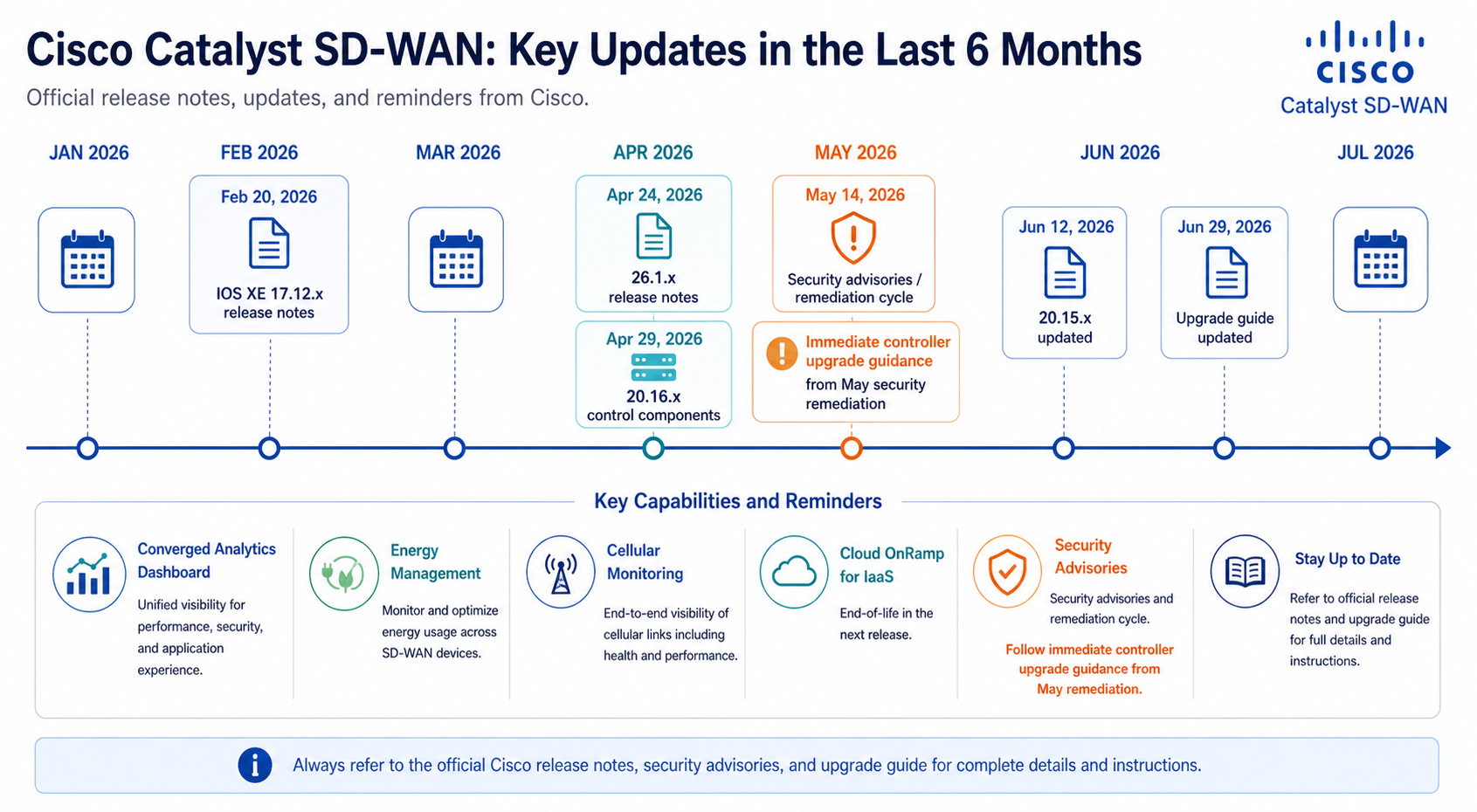
A timeline view of the release and operations milestones that mattered most from January through July 2026.
1. The release cadence itself is the first operational signal
Cisco did not present the last six months as a single story, but in practice the sequence tells one. IOS XE 17.12.x release note updates on February 20, 2026 reinforced the branch reality that many enterprises are still operating mixed platform and feature expectations at the edge. Then the 26.1.x release note update on April 24, 2026, the 20.16.x controller-component update on April 29, 2026, the May 2026 remediation cycle, the 20.15.x update on June 12, 2026, and the June 29, 2026 upgrade-guide refresh all combined into a practical planning message: operators need to think in terms of branch intent, not just version numbers.
That matters because Catalyst SD-WAN environments rarely live in a clean laboratory state. Real deployments have edge hardware diversity, cloud attachments, varying security service dependencies, and different appetites for operational change. A branch decision affects more than device code. It affects how much observability you get, how you onboard cloud and security services, what controller-side workflows are available, and how much effort it will take to keep the environment inside a supported and secure posture.
The updated Cisco upgrade guidance in late June 2026 is important for that reason alone. Even when the technical content of a release is attractive, the safer question is whether that release fits your path from your current state. Skilled SD-WAN teams know that the best upgrade target is not always the newest branch. It is the branch that aligns with your hardware support, your controller state, your feature dependencies, and your risk tolerance for change windows.
2. Cisco kept improving the operational center of gravity: SD-WAN Manager
One of the clearest themes across the 20.15.x and 20.16.x controller updates is that Cisco keeps treating SD-WAN Manager as more than a configuration surface. The platform continues moving toward a broader control, visibility, and operational workflow role. For operators, that is important because it changes where daily value is supposed to come from. The manager is increasingly expected to be the place where policy, device state, analytics, and troubleshooting context come together.
In 20.15.x, Cisco highlighted a converged analytics dashboard, which matters because mature SD-WAN programs eventually stop asking for more raw data and start asking for fewer context switches. A converged view of network, application, and security analytics reduces the friction of moving between multiple operational lenses. That does not eliminate the need for deeper tooling, but it does improve the quality of first pass triage. For NOC, SOC, and network engineering teams, faster triage translates directly into lower response time and less guesswork.
Cisco also called out admin-tech customization in 20.15.x. That may sound small compared with a major feature launch, but experienced operators know why it matters. When escalation data collection is noisy, incomplete, or hard to standardize, every incident drags. Better admin-tech control means cleaner evidence, more repeatable troubleshooting, and less time spent collecting the same information manually during pressure situations.
Another 20.15.x theme was operational simplification, including support such as EtherChannel configuration-group handling and SSE traffic-context sharing. Those are not merely checkbox items. They are signals that Cisco is still smoothing the boundaries between branch connectivity, policy consistency, and the adjacent service stack that increasingly defines enterprise WAN outcomes.
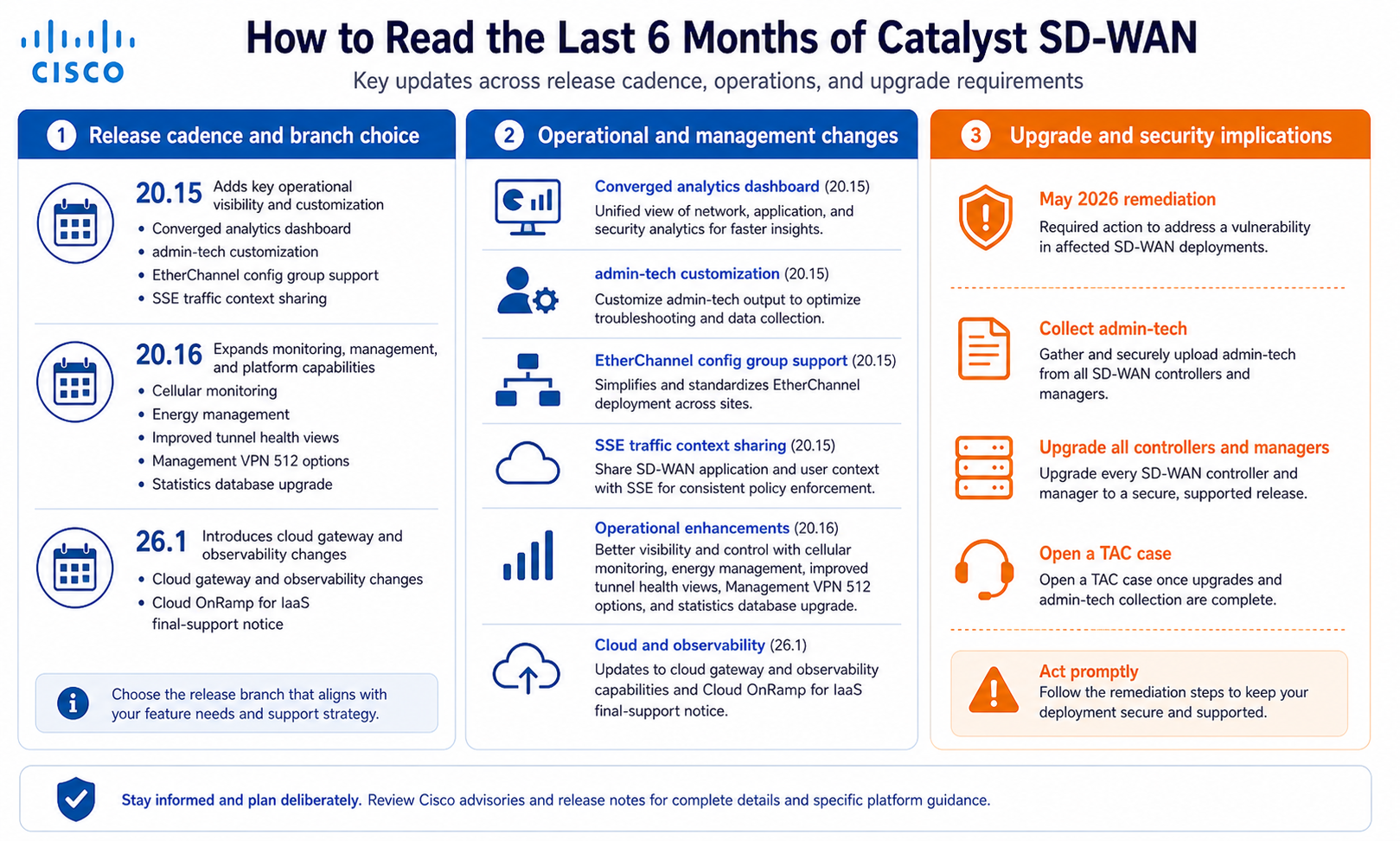
Recent controller, branch, analytics, and cloud-facing enhancements matter because they improve how teams operate the WAN, not just how they configure it.
3. 20.16.x added practical visibility and management improvements
If 20.15.x improved the operating surface, 20.16.x added several practical workflow improvements that matter to experienced teams. Cisco highlighted better monitoring for cellular-enabled devices, an energy-management dashboard, improved tunnel-health views across multiple remote devices and circuits, remote AAA support over Management VPN 512, webhook notifications over Management VPN 512, and a statistics-database upgrade. None of those items is flashy on its own. Together, they are exactly the kinds of changes that make daily operations less brittle.
Take cellular monitoring. Many WAN teams rely on LTE or 5G paths either as primary connectivity in selected sites or as part of a resilience design. Better visibility into those links matters because cellular issues often look intermittent and easy to misread. Improved monitoring means a better chance of separating provider instability, signal-quality problems, and policy side effects from the beginning of an incident instead of after hours of back-and-forth.
The same is true for improved tunnel-health visibility across multiple remote devices and circuits. As SD-WAN deployments become denser and more distributed, tunnel behavior is increasingly a topology problem, not a single-device problem. Better visualization and monitoring across multiple remote peers helps teams reason about blast radius faster. That is useful during brownouts, underlay instability, or application complaints that might otherwise be blamed on the wrong site.
Remote AAA over Management VPN 512 and webhook notifications over that same management path also deserve attention. Those updates speak to operational integrity. They help keep management-plane workflows secure and usable even when the data-plane discussion gets messy. For teams that care about secure remote administration, eventing, and integration into broader operational tooling, those changes are a sign that Cisco is still investing in the mechanics that make the platform manageable at scale.
Even the statistics-database upgrade is more important than it sounds. Reliable analytics depends on a data layer that can keep up with operational demand. If Cisco is improving that part of the system, operators should read it as a signal about scale, performance, and the growing importance of analytics-driven workflow inside the product.
4. Cloud and multicloud planning stayed firmly on the table
The 26.1.x update in late April 2026 is another reason this six-month period matters. Cisco’s release activity continued to reinforce the idea that cloud and multicloud connectivity remains a first-class WAN concern rather than an edge case. Updates around cloud gateways and observability keep that direction intact, and the Cloud OnRamp for IaaS final-support notice is the kind of detail experienced teams should not ignore. End-of-life and final-support notices often drive more work than a feature launch because they force architecture decisions under time pressure.
For some organizations, this will mean straightforward migration planning. For others, it will require a deeper review of how branch, cloud, security, and application-performance expectations have evolved since the environment was first deployed. Either way, the signal is clear: cloud attachment strategies in Catalyst SD-WAN should be reviewed as part of normal lifecycle planning, not postponed until support deadlines become operational risk.
This is also where a service partner can add real value. Many teams know their current design works, but they are less certain that it still matches current Cisco branch strategy, security requirements, and observability expectations. ITSulu can help close that gap by reviewing the deployed design, mapping it to current release behavior, and building an upgrade or modernization path that respects production constraints.
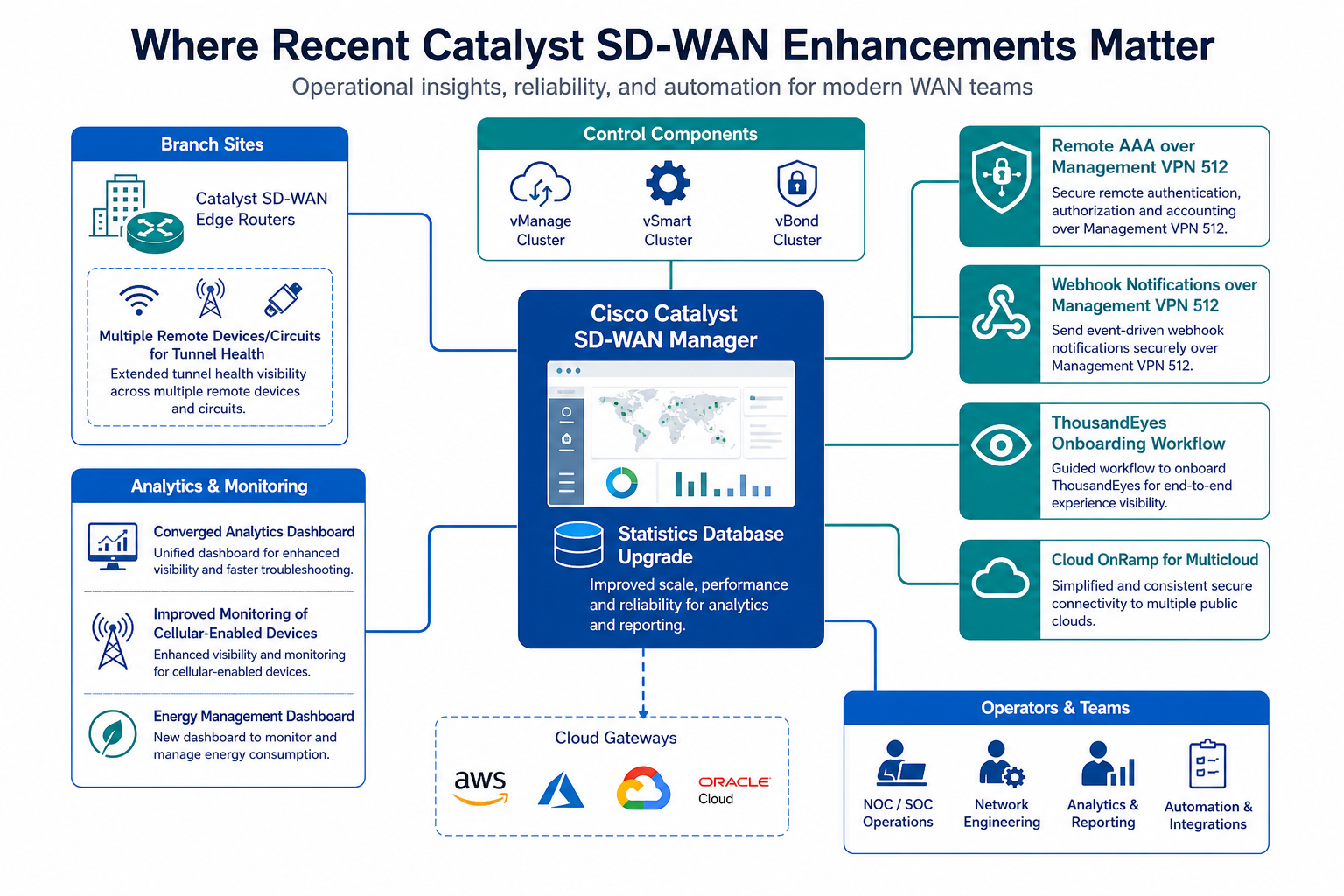
The right reading of recent SD-WAN changes is not feature-by-feature in isolation. It is how release cadence, operational tooling, and upgrade discipline interact in production.
5. May 2026 reinforced the security and upgrade discipline story
The most important non-feature signal in the six-month window may be the May 2026 remediation guidance for Catalyst SD-WAN security issues. Security advisories are always important, but what matters operationally is the response pattern they force. In this case, the emphasis on upgrading controllers and managers, collecting admin-tech data, and engaging TAC where appropriate was a reminder that controller health and software currency are part of the security posture of the WAN, not a separate concern.
For knowledgeable SD-WAN practitioners, this should strengthen a broader operating principle: the control plane deserves the same disciplined lifecycle treatment that organizations already apply to perimeter security infrastructure. If the environment still treats controller upgrades as exceptional or inconvenient, the last six months offer a good argument for changing that model. The more central SD-WAN Manager becomes to analytics, operations, and integration, the more important it is to keep the platform secure, supported, and predictable.
6. What this means for experienced SD-WAN teams right now
If you run Catalyst SD-WAN today, the practical takeaway is not simply “upgrade.” It is “re-evaluate with intent.” Review which code train your environment is actually on, how your controller state aligns with Cisco’s current guidance, whether your team is using the newer operational visibility improvements effectively, and whether your cloud and security-service assumptions still match the product direction. In many environments, the biggest gap is not licensing or hardware. It is that the deployment has drifted away from current operational best practice.
That re-evaluation should include branch selection, controller lifecycle, management-plane access design, eventing integrations, analytics usage, and cloud-attachment planning. It should also include a sober look at how upgrades are tested and rolled out. The June 29, 2026 upgrade-guide refresh is valuable because it encourages exactly that kind of deliberate path planning instead of impulsive version chasing.
This is the kind of work ITSulu does well. We help teams move from scattered release awareness to an actionable plan: what changed, what matters in their specific environment, what to upgrade, what to retire, what to validate in staging, and how to reduce operational risk while improving visibility and resilience. For Cisco Catalyst SD-WAN programs, that often means turning a pile of release notes into an actual engineering roadmap.
7. Why ITSulu is a useful partner for this moment
The last six months of Cisco Catalyst SD-WAN updates are a good example of why experienced teams still benefit from an outside engineering partner. The challenge is rarely understanding one feature in isolation. The challenge is integrating release guidance, security posture, cloud design, controller operations, and business constraints into one coherent operating model. That is where ITSulu can help with architecture review, upgrade planning, automation, operational runbooks, and day-two support for Catalyst SD-WAN environments.
If your team wants help assessing release strategy, building a safer upgrade sequence, modernizing controller operations, or aligning Catalyst SD-WAN with SASE and multicloud direction, ITSulu can work alongside your engineers in a practical way. The goal is not to replace your internal expertise. It is to make that expertise more effective and easier to apply under real-world time and production constraints.
This summary reflects Cisco release notes, upgrade guidance, and security-remediation material published or updated during the January 6, 2026 through July 6, 2026 window. For detailed platform-specific applicability, teams should still review the official Cisco documentation directly. If you want help translating those updates into a concrete SD-WAN roadmap, ITSulu is ready to help. Read the post online here: https://itsulu.com/blog/itsulu-insights-2/latest-cisco-catalyst-sd-wan-updates-last-6-months-90.