A Kubernetes cluster can be a wonderful thing when everything is running. It can also become a very busy place once backups, databases, updates, restores, and operators all start asking for attention at the same time. That is where a practical stack like k8up + Kopia, CloudNativePG, and mariadb-operator earns its keep. Instead of treating backup and database operations as separate chores, this combination helps turn them into a more organized system.
For a general audience, the value is easy to understand. Backups protect you when something breaks. Database operators keep important data services running with less manual effort. Together, they reduce the chance that one mistake, one failed pod, or one bad upgrade turns into a long outage. For businesses, that means less risk, less downtime, and fewer late-night emergencies. For IT teams, it means more predictable operations. For customers, it means better service continuity.
ITSulu helps organizations design Kubernetes platforms that are meant to be operated, not just admired in a diagram. That matters because the real test of a cluster is not the day it is installed. The real test is the day you need to recover, upgrade, or move data safely without stopping the business.
1. Why backup and database operations belong together
Many Kubernetes projects start by focusing on application deployment. That is natural. But once data enters the picture, the cluster needs more than scheduling and scaling. It needs a way to protect information, restore it quickly, and keep stateful services healthy over time. That is why backup tools and database operators should be planned together instead of as afterthoughts.
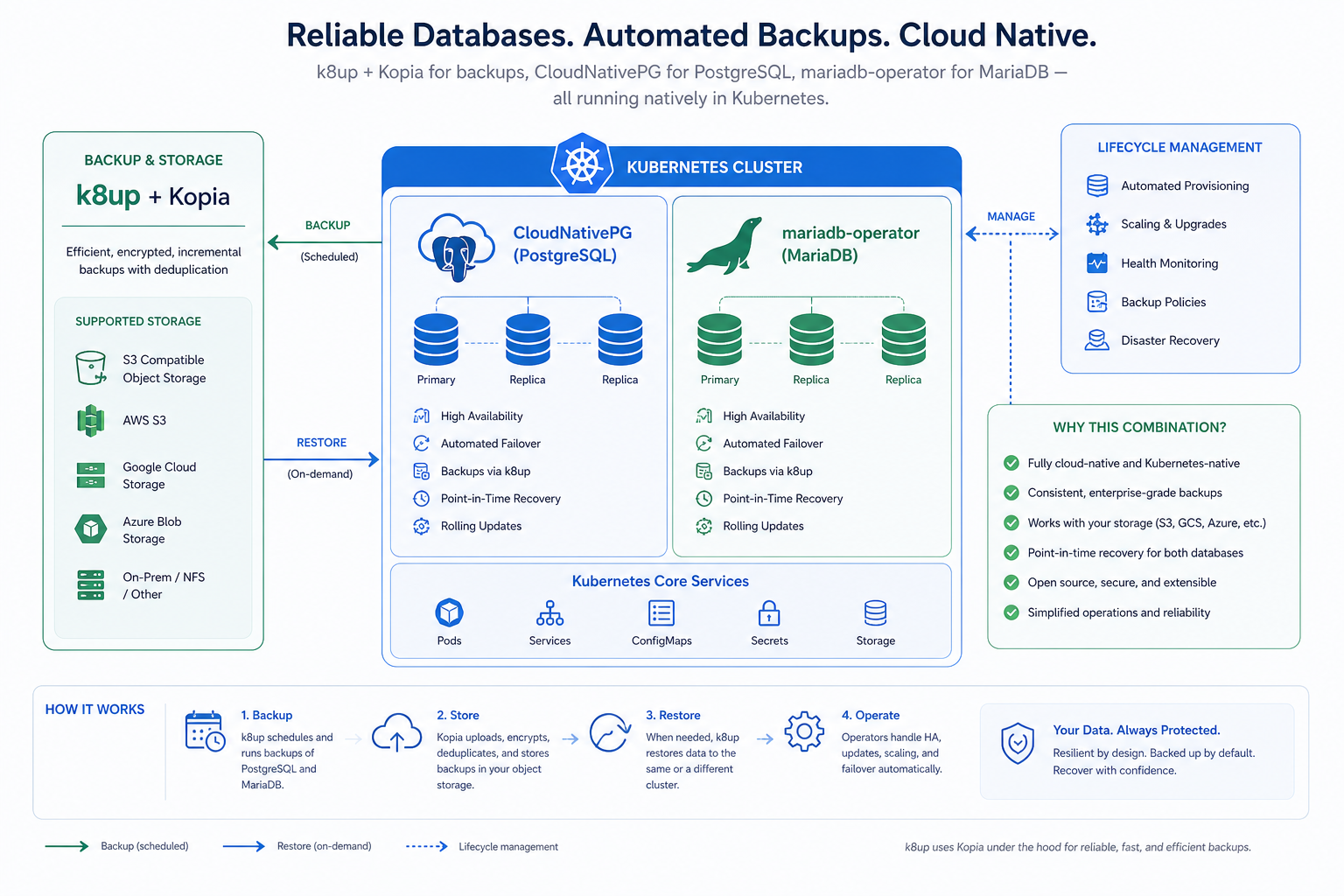
k8up and Kopia address the backup side of the story. k8up gives Kubernetes teams a way to schedule and manage backups in a cluster-native way, while Kopia brings efficient repository storage with encryption, deduplication, and incremental snapshotting. In plain language, that means you can back up data more often without storing a giant duplicate of everything every time. That saves storage, reduces transfer overhead, and makes backups easier to use in practice.
CloudNativePG and mariadb-operator address the database side. Rather than forcing a team to hand-manage every database task, these operators automate common work such as cluster health, failover, updates, and day-to-day lifecycle management. That helps turn databases into managed services inside the cluster instead of fragile pets that need constant babysitting.
2. What k8up + Kopia adds to a cluster
Backups are not glamorous, but they are one of the best investments a cluster can have. k8up gives teams a Kubernetes-native way to define when backups should happen and how they should be managed. Kopia makes the storage side smarter by using encryption, deduplication, and incremental snapshots so the backup set grows more efficiently and remains easier to protect.
The business benefit is simple. You are less likely to lose critical work, and you are more likely to recover quickly if something goes wrong. The operational benefit is just as important. Instead of building a custom backup script for every workload, the team can rely on a pattern that is repeatable and easier to audit. That matters when a cluster has a mix of services, databases, and persistent volumes that all need protection in a consistent way.
For a public-facing service, the question is never only, "Did we back it up?" The real question is, "Can we restore it when we need it, and can we do that without scrambling?" k8up and Kopia make that easier to answer because they turn backup into a routine part of cluster operations rather than a special project.
That matters even more when a company is growing. A small team may get away with a few manual steps. A larger environment cannot. At some point, the cost of manual handling becomes higher than the cost of automation, and that is where k8up plus Kopia begins to pay for itself.
3. What CloudNativePG does for PostgreSQL
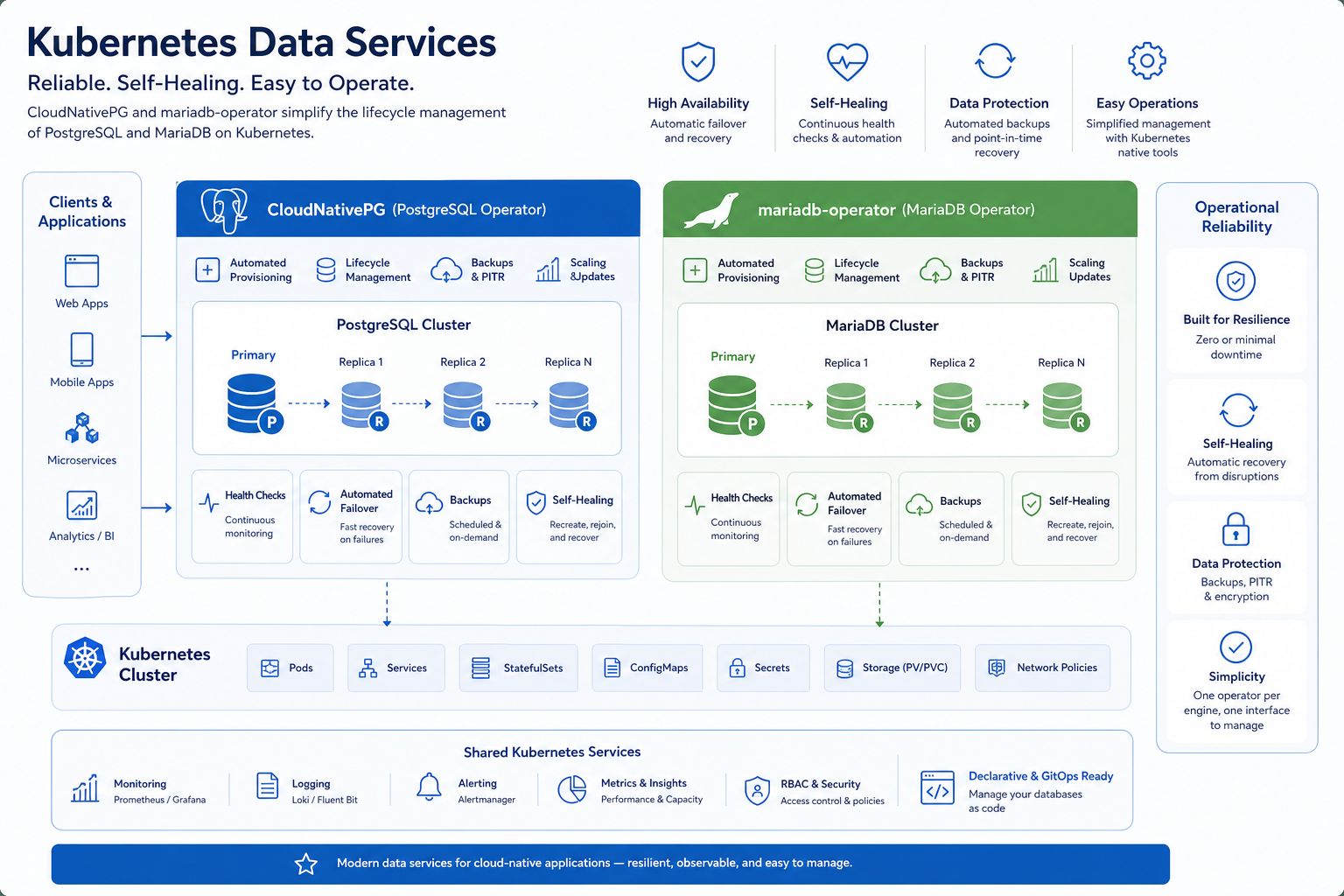
PostgreSQL is one of the most common database engines in modern software, and CloudNativePG is built to help it run well inside Kubernetes. The operator handles the cluster lifecycle so administrators do not have to manage every database node by hand. That includes health checks, high availability patterns, backup support, and failover behavior that can help the service keep going when one node has a problem.
For most organizations, that means less fear around routine operations. A database upgrade no longer feels like a one-off gamble. A failover event is less likely to become a panic because the operator is already designed to manage the cluster as a system, not as disconnected servers. If PostgreSQL is part of a customer portal, internal app, reporting stack, or CRM workflow, that stability has direct business value.
CloudNativePG also encourages a cleaner operational habit. Instead of logging into a server and improvising, the team defines the desired state and lets the operator do the heavy lifting. That makes the environment easier to document, easier to monitor, and easier to hand off between people. It also gives leaders more confidence that the database layer is not depending on hidden tribal knowledge.
4. What mariadb-operator adds for MariaDB
MariaDB is still widely used in real-world applications, especially where teams want a familiar relational database with broad tooling and a long history of support. mariadb-operator brings Kubernetes-native management to that world. Instead of treating MariaDB as a sidecar to the cluster, the operator helps manage the database as part of the platform.
That can include cluster provisioning, operational health, recovery workflows, and the kind of automation that keeps routine tasks from becoming manual chores. In practical terms, this means teams can run mixed database environments more consistently. If one service depends on PostgreSQL and another depends on MariaDB, the platform can still follow a shared operational pattern instead of forcing the team to maintain two completely different ways of thinking about stateful workloads.
That consistency is good for everyone. Developers get a clearer platform. Operators get less surprise. Business owners get fewer gaps in service. And if the team needs to recover from an outage, the operator-driven approach makes that process easier to rehearse and easier to trust.
For organizations with multiple products or multiple database generations, that flexibility matters. It lets the platform support what exists today while still leaving room to modernize over time.
5. Why the combination works so well
The real advantage of this stack is that each piece covers a different layer of the problem. k8up plus Kopia focuses on protection and restore. CloudNativePG focuses on PostgreSQL operations. mariadb-operator focuses on MariaDB operations. Put together, they help a Kubernetes environment become safer, more automated, and much easier to operate at scale.
This combination also reduces the burden on the people running the cluster. Instead of building ad hoc scripts and one-off maintenance tasks, the team gets a more standardized way to handle backup, failover, and lifecycle management. That means fewer hidden failure points and less dependence on one engineer remembering the magic steps.
There is another benefit that is easy to miss: confidence. Teams move faster when they trust the platform. They deploy more willingly when they know restore paths exist. They upgrade more calmly when the database layer is managed. They respond to incidents more effectively when the platform has clear controls instead of improvisation. Confidence is not a soft benefit. It is what allows the rest of the business to keep moving.
6. The business case in plain language
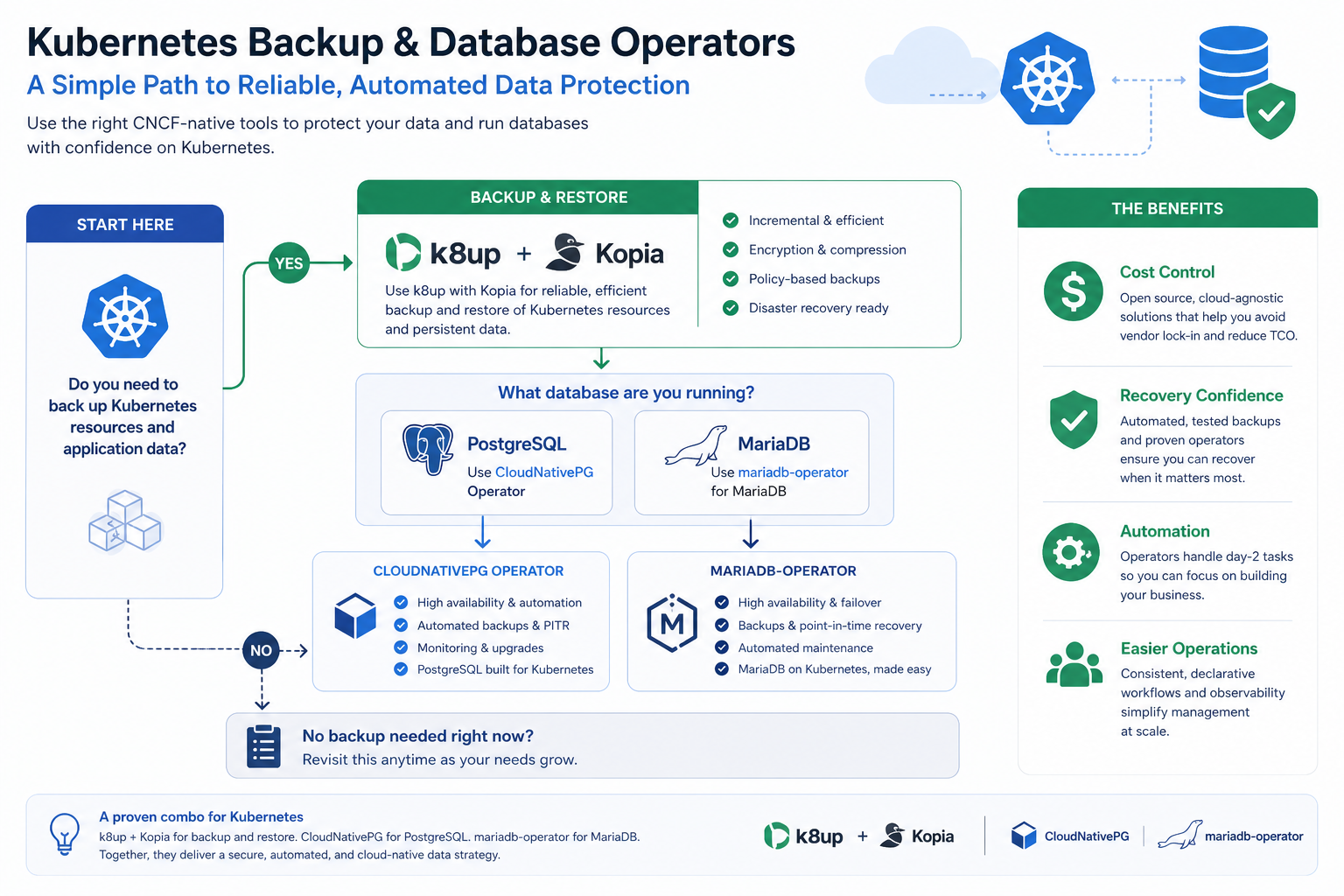
To a non-technical reader, the business case sounds like this: if your cluster handles customer data, transactions, reporting, or content, you want a way to protect that data and recover it without panic. You also want the databases behind those services to be managed in a way that reduces manual intervention. This stack does both.
That translates into lower operational risk, better continuity, and less wasted time. It can also mean easier compliance conversations because the organization has a clearer story about backup, recovery, and database management. And if the business grows, the platform is less likely to collapse under the weight of its own success.
There is a cost angle too. Efficient backups reduce storage waste. Operator-driven automation reduces labor waste. Faster recovery reduces outage cost. Those are real savings, even if they are not always visible on day one. Over time, they become part of the reason a Kubernetes platform remains affordable to run.
That is where ITSulu fits in. We help teams choose the right stack, wire the pieces together, and build the operational habits that keep the system reliable after launch. A good design is not just technically neat. It is something the team can actually live with.
7. Why this matters for real teams
The most common mistake in infrastructure work is to treat resilience as an optional extra. In reality, resilience is the product. If the backups are unreliable, the platform is risky. If the database operations are manual, the platform is expensive to run. If recovery is unclear, the platform is fragile.
k8up + Kopia, CloudNativePG, and mariadb-operator help change that equation. They make data protection and database management feel less like a collection of emergencies and more like part of the normal operating model. That is the kind of foundation a serious business can build on.
For companies that want to run Kubernetes with less drama and more confidence, this stack is a strong place to start.
How ITSulu Can Help
ITSulu helps organizations design and operate Kubernetes environments that are practical, resilient, and easier to maintain. That includes choosing backup patterns, implementing database operators, integrating monitoring, and creating runbooks that make the platform understandable to the whole team.
If you want your Kubernetes cluster to be easier to restore, easier to manage, and easier to trust, ITSulu can help turn that into a working operating model.