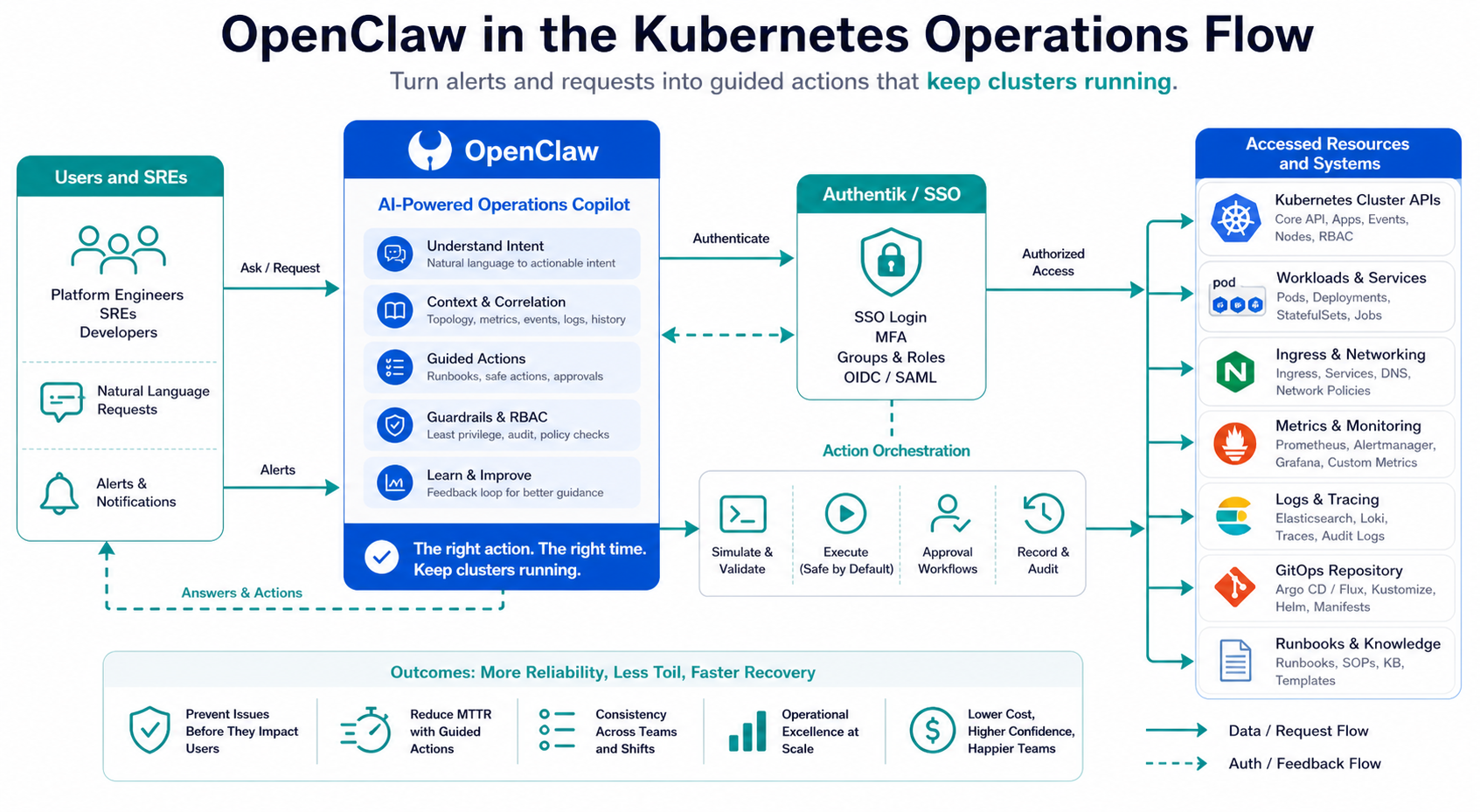
Keeping a Kubernetes cluster running is rarely about one dramatic fix. It is usually about a hundred small moments where the platform either gives the operator enough context to act or leaves them guessing. OpenClaw fits into that gap. In ITSulu’s approach, OpenClaw acts like an AI resident engineer that sits beside the normal Kubernetes toolchain and helps turn a noisy environment into a manageable one.
For experienced Kubernetes users, the value is not that OpenClaw understands what a Deployment is. It is that OpenClaw can connect the dots between Deployments, Services, Ingress, nodes, PVCs, logs, alerts, and the GitOps state that is supposed to describe the cluster. That means the platform is not just watching for problems. It is trying to explain them in terms a human can use right away. The result is faster diagnosis, safer action, and less time spent manually stitching together clues from five different screens.
That matters because most outage time is not spent executing the fix. It is spent figuring out what the real problem is. OpenClaw helps compress that early part of the incident so the team can spend more of its energy on recovery and less on spelunking.
What OpenClaw actually contributes
In a serious Kubernetes environment, the practical question is not whether the cluster has observability. Most clusters do. The question is whether the observability stack is helping the team decide what to do next. OpenClaw is useful because it sits on top of the cluster’s existing source of truth and operational memory. It can ingest signals from the platform, compare them against known topology and prior incidents, and present a response that is closer to an operator’s reasoning than a raw alert feed.
That opens up several useful jobs. OpenClaw can summarize a failure in plain language. It can correlate a symptom in one namespace with a dependency issue elsewhere. It can point at the GitOps record that probably introduced a behavior change. It can suggest the next safest action and, when the workflow allows it, help execute that action under human approval. The important detail is that OpenClaw does not replace the cluster operator. It gives the operator a faster, more consistent starting point.
For ITSulu, that is the service proposition: help teams keep clusters running by turning uncertain incidents into guided operational loops. The AI layer is not a novelty feature. It is a way to reduce toil and preserve response quality when the environment is under stress.
Faster detection is only half the battle
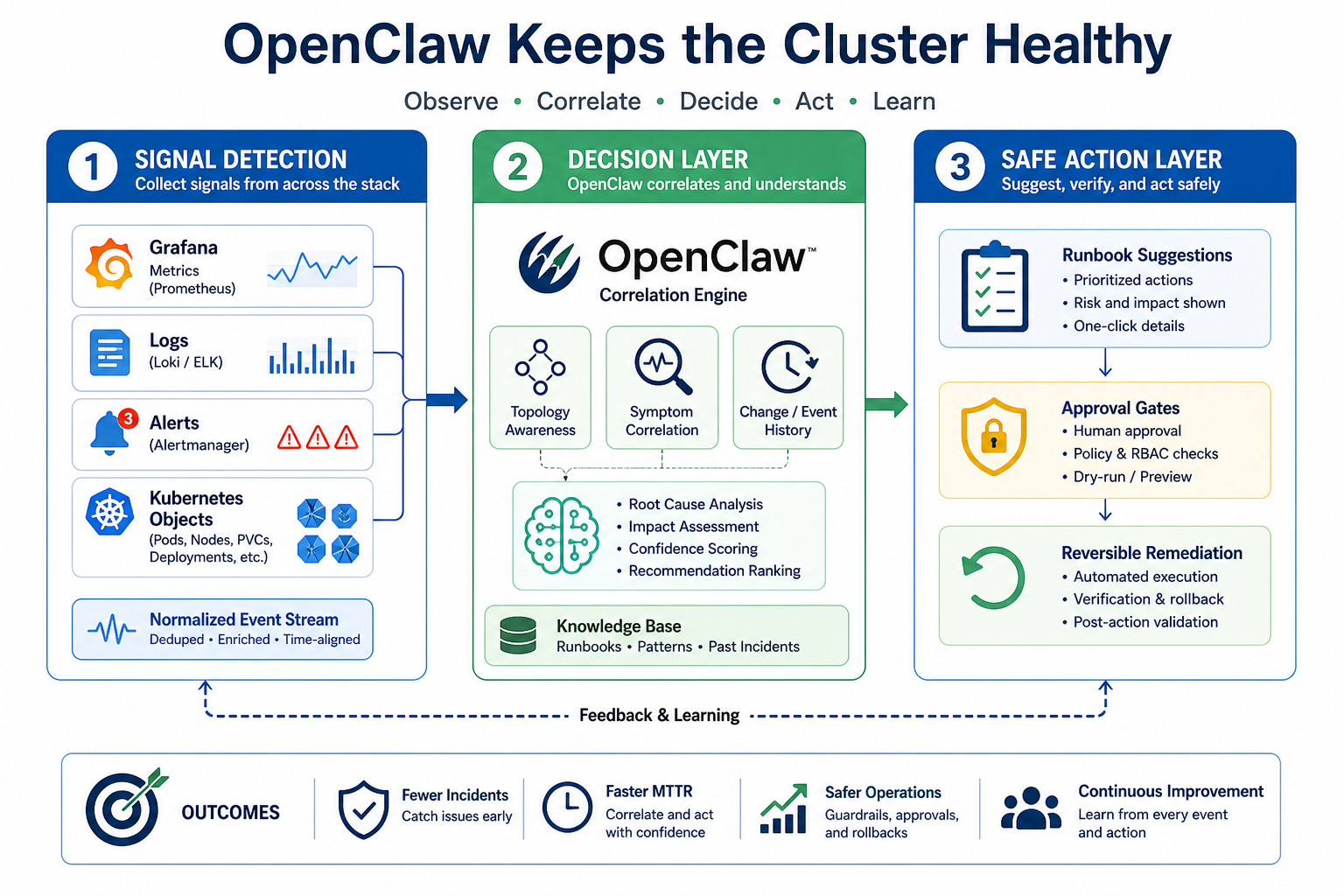
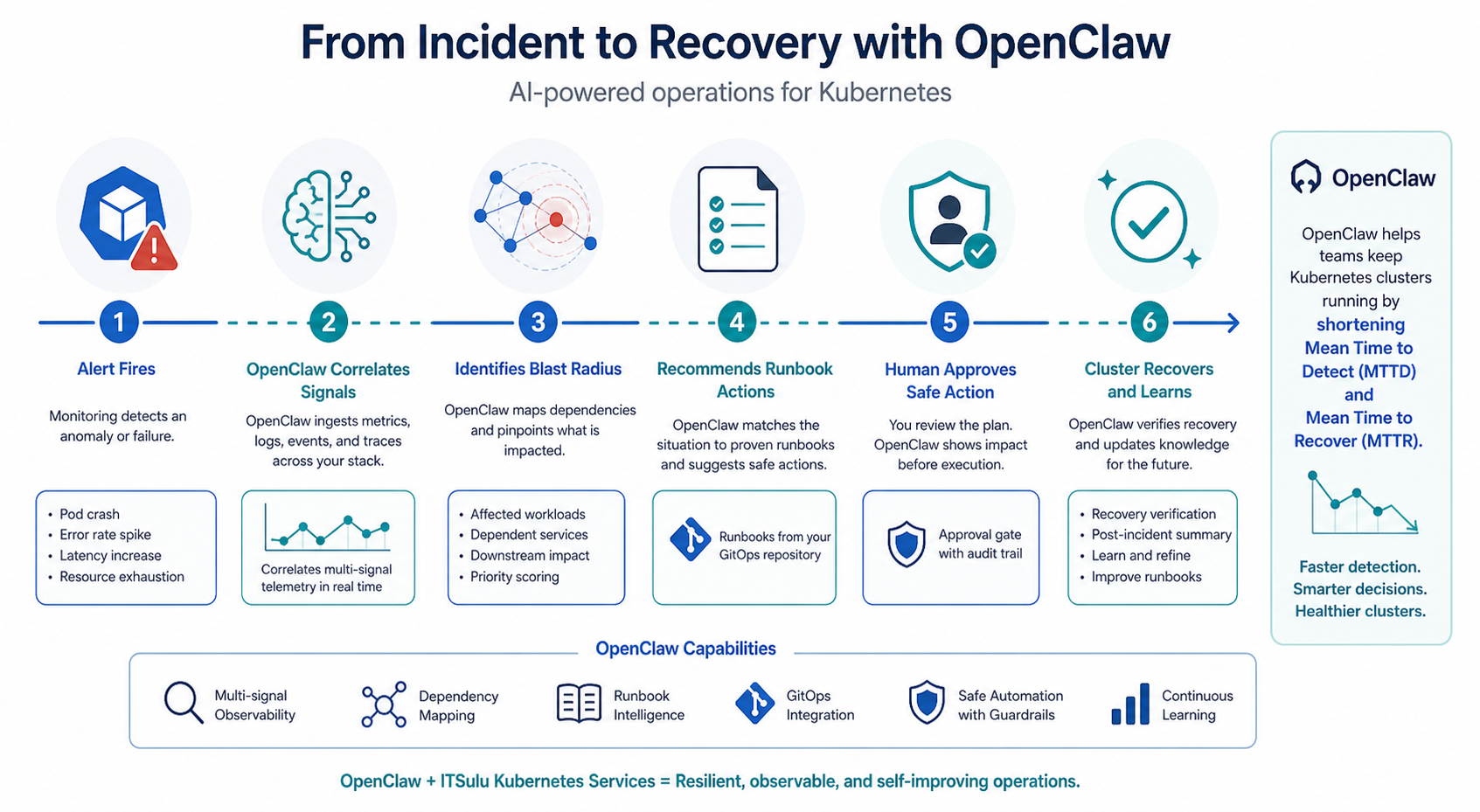
Every Kubernetes team wants better alerting. Fewer false positives, better routing, less noise. But even excellent alerting still leaves a gap: the team has to decide which symptom matters first. A pod restart by itself is not very meaningful. A pod restart after a node pressure event, a failing liveness probe, and an ingress 502 is a different story. OpenClaw is valuable because it can treat those symptoms as a related set instead of isolated facts.
That correlation step is where AI adds something beyond ordinary dashboards. Humans are good at pattern recognition, but they are slow when they have to do it from scratch during every incident. OpenClaw can preserve context from earlier failures, notice when the current event resembles a known pattern, and surface the likely blast radius. That does not mean it should make the final call on its own. It means the team gets a useful hypothesis before the outage consumes more time.
For example, a service may be failing because a secret was updated incorrectly, because an upstream certificate expired, or because a storage class stopped binding volumes. OpenClaw can help separate those branches quickly by checking the surrounding signals. The practical win is MTTR: lower mean time to recovery, and often lower mean time to understand the problem in the first place.
At ITSulu, this is the kind of help that matters most in production. The platform should not need a hero every time a certificate or dependency changes. It should need a tool that can narrow the search space and keep the incident moving toward resolution.
Safe action, not blind automation
There is a reason experienced Kubernetes teams stay cautious around automated remediation. A tool that restarts the wrong thing or patches the wrong manifest can make a bad day much worse. OpenClaw is useful precisely when it respects that boundary. The right pattern is recommendation first, approval second, action last. The system should surface what it thinks is broken, explain why it thinks so, and outline the lowest-risk path back to health.
In a GitOps-first environment, that might mean OpenClaw points to the manifest change that likely caused the failure, suggests a rollback, and waits for a human to approve the sync. In an operational incident, it might suggest scaling a dependency, reissuing a secret, restarting a crashing pod set, or checking a PVC that is not mounting. In every case, the important thing is that the guidance is specific enough to help but conservative enough to avoid collateral damage.
This is where OpenClaw lines up nicely with ITSulu k8s services. The service is not just “AI for the cluster.” It is an operational workflow that can sit inside the existing security model, observability stack, and change-control discipline. That makes it easier for technical teams to trust the assistant without turning it loose on production state.
OpenClaw is strongest when it knows the cluster’s memory
Kubernetes teams do not just need live telemetry. They need memory. They need to know what changed yesterday, what was approved last week, what broke during the last node upgrade, and what runbook the team already trusts. OpenClaw becomes much more useful when it can draw on that operational memory instead of relying only on the current snapshot.
That memory can include Git history, deployment manifests, previous incident notes, alerts, runbooks, and environment specific conventions. Once those pieces are connected, OpenClaw can answer much better questions. Not just “What is broken?” but “What usually breaks here?” and “What did we do the last time this exact dependency drifted?” That is a very different kind of support than a generic chatbot provides.
For advanced Kubernetes users, this is where the service becomes sticky in the best sense. It reduces the cognitive load of running the platform by carrying forward the facts that humans usually have to keep in their heads. When the team grows, that matters even more. New operators do not have to learn every historical quirk from scratch, and senior operators spend less time being the only source of institutional memory.
That is also why OpenClaw can be a good fit for environments with multiple clusters or multiple business units. It can preserve enough local context to be useful without forcing every incident into a one-size-fits-all playbook.
What it means for uptime and operations
The most obvious business benefit is uptime. Better correlation and safer remediation usually translate to shorter incidents and fewer repeat failures. But the deeper benefit is operational consistency. A platform that handles incidents the same way every time is easier to trust, easier to improve, and easier to hand off. Teams stop relying on ad hoc tribal knowledge and start relying on a repeatable workflow.
That consistency affects more than emergency response. It helps during maintenance windows, certificate renewals, node rotation, storage recovery, and application rollouts. OpenClaw can be used to guide routine work too, not just failures. That means less context switching for engineers and fewer gaps between “we know what should happen” and “we actually executed it correctly.”
There is also a cost argument. When incidents take less time, on-call load goes down. When postmortems become clearer, the same problem is less likely to recur. When the team does not need to invent a new response every time, it preserves both attention and budget. For organizations that run Kubernetes as a serious production platform, that can be the difference between a cluster that feels like an asset and one that feels like a maintenance liability.
How ITSulu would deliver OpenClaw for a Kubernetes team
ITSulu’s value is not in dropping a single model into the cluster and calling it a day. The value is in shaping the workflow around how the cluster is actually operated. That means integrating OpenClaw with the security boundary, connecting it to the observability stack, anchoring it in GitOps, and making sure the outputs are actionable for the people who already own the platform.
In practice, that can include Authentik-backed access, cluster-specific knowledge bases, guarded actions, clear approval paths, and a clean separation between recommendations and state changing operations. It can also include curated runbooks, known-failure patterns, and a feedback loop that learns from incidents without overpromising autonomy. The goal is a system that helps operators move faster while still leaving them in charge.
For mature teams, that approach is attractive because it does not ask them to abandon their current way of working. It makes the current way of working sharper. For growing teams, it is even more valuable because it reduces the amount of tribal knowledge they need to carry to keep the cluster healthy.
Why this matters to technical buyers
If you already know Kubernetes, the sales pitch that lands is not “AI magic.” It is operational leverage. OpenClaw helps you keep clusters running by making the control loop tighter: detect faster, understand sooner, act more safely, and remember more of what happened. That can be the difference between a platform that only looks sophisticated and a platform that actually behaves like a reliable production system.
For leadership, the benefit is lower risk and less time lost to outages. For engineers, the benefit is less toil and more signal. For the organization, the benefit is that the cluster becomes easier to run instead of harder every time the environment grows or changes.
That is exactly the kind of outcome ITSulu wants to deliver: practical Kubernetes services that make the platform steadier, the team calmer, and the business more resilient.
How ITSulu Can Help
ITSulu can help design, integrate, and operate an OpenClaw workflow that fits your Kubernetes environment. That includes the architecture around the assistant, the operational knowledge it should use, the approval boundaries it must respect, and the recovery paths it should recommend. The result is not just an AI feature. It is a support layer for keeping production clusters healthy and understandable.
If you want to explore OpenClaw as part of your Kubernetes operating model, ITSulu can help turn the idea into something your team can actually use.
Contact ITSulu to discuss OpenClaw and Kubernetes operations.