Kubernetes gives you a self healing control loop for containers. It does not give you a self healing control loop for the messy, ambiguous, human shaped problems that show up in every cluster: a Helm chart that half upgraded, a PVC stuck in Terminating, a Crash Loop Back Off whose root cause is three services away from where the alert fired. That gap between "the reconciler retried" and "the actual problem is fixed" is where most on call hours go.
This post looks at what happens when you put local, open weight language models — Gemma 4 12B and Ministral 3 14B — behind OpenClaw, an agentic operations layer that can read cluster state, propose changes, and act on them under policy. We run this exact stack inside ITSulu's own Kubernetes environment, so this is a report from production, not a thought experiment.
Why the model choice matters for cluster operations
Most "AI for ops" pitches assume you'll call a hosted frontier model over the internet for every diagnostic step. That has two consequences operators care about: your cluster's internal state (secrets, topology, traffic patterns, customer data shapes) leaves the network on every query, and your incident response now has an external dependency with its own latency and uptime.
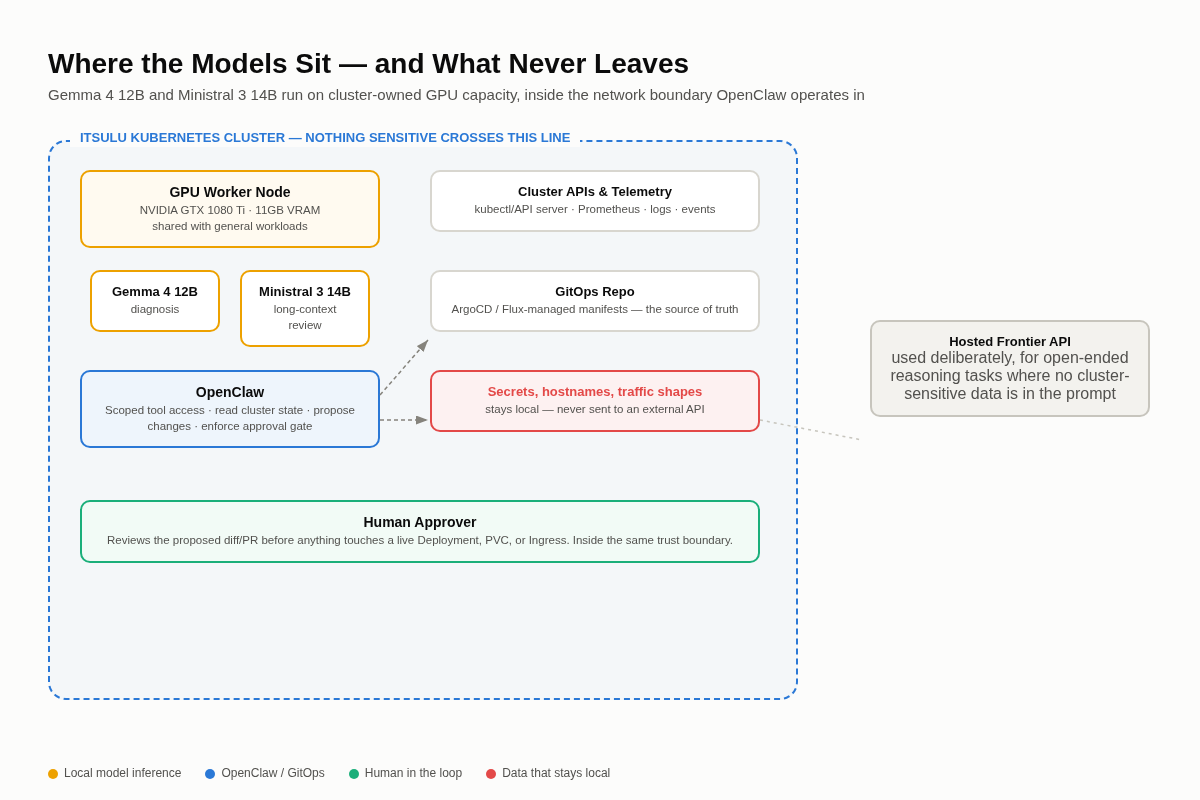
Gemma 4 12B and Ministral 3 14B matter because they are small enough to run on a single capable GPU worker — in our case an older NVIDIA GTX 1080 Ti 11GB node already doing double duty as a general worker — and strong enough to do real reasoning over YAML, logs, and shell output. Neither needs to leave the cluster's network boundary.
- Gemma 4 12B is the workhorse for structured reasoning: parsing
kubectl describeoutput, correlating events across resources, and drafting remediation plans in a consistent format OpenClaw can parse back into actions. - Ministral 3 14B earns its keep on long context synthesis: ingesting a wide slice of logs, Prometheus alert history, and Git commit messages at once to answer "what changed before this started failing?" — the question every postmortem starts with.
Running two models side by side, rather than one generalist, means each one stays in its lane. Gemma proposes the fix; Ministral checks it against the wider blast radius before anything executes.
Where OpenClaw sits in the loop
OpenClaw is the piece that turns model output into cluster action and, just as importantly, turns cluster state into model input. Left to themselves, LLMs hallucinate plausible looking kubectl commands. OpenClaw constrains that by giving the models a fixed toolset (read-only cluster queries, scoped write actions, Git operations against your GitOps repo) and enforcing a proposal then approval pattern before anything touches a live Deployment, PVC, or Ingress.
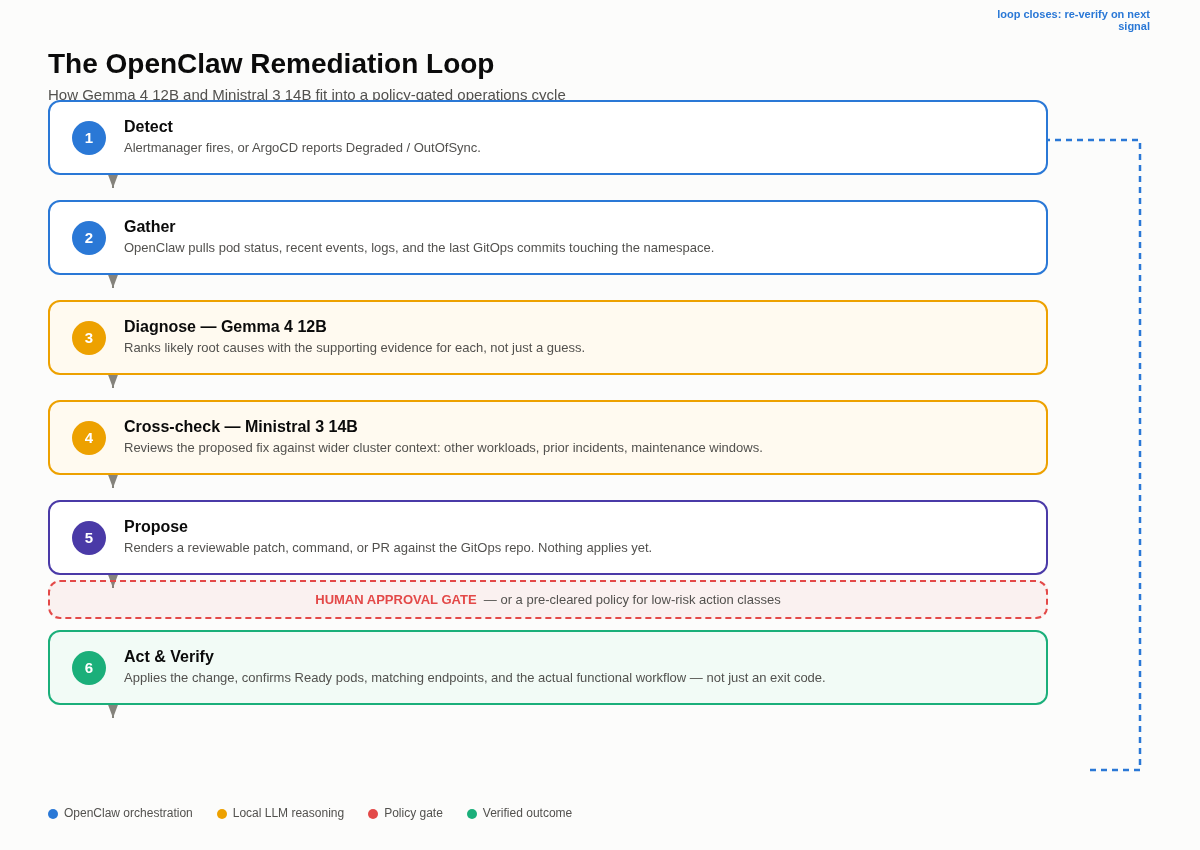
In an k8s cluster, that loop looks roughly like this:
- Detect. An alert fires (via Alertmanager, or a webhook from ArgoCD reporting OutOfSync/Degraded).
- Gather. OpenClaw pulls pod status, recent events, relevant logs, and the last few GitOps commits touching that namespace, and hands them to Gemma 4 12B.
- Diagnose. Gemma produces a ranked list of likely root causes with the evidence for each — not just "pod crashed" but "pod crashed because the ConfigMap checksum annotation didn't roll the Deployment, so it's still reading the stale mount."
- Cross-check. Ministral 3 14B reviews the proposed fix against a wider context window — other workloads sharing the node, recent similar incidents, upcoming maintenance windows — and flags anything the narrower diagnosis missed.
- Propose. OpenClaw renders a concrete, reviewable change: a patch to a HelmRelease values file, a one-line kubectl command, or a PR against the GitOps repo. Nothing applies without either policy-based auto-approval for pre-cleared action classes, or a human clicking approve.
- Act and verify. Once approved, OpenClaw applies the change, watches for the expected state (Ready pods, matching endpoints, ArgoCD back to Synced/Healthy), and reports back with before/after evidence — not just an exit code.
That last step matters more than it sounds. A remediation that returns HTTP 200 or shows a pod in Running is not evidence the actual problem is fixed. OpenClaw is built to chase the same standard ITSulu holds its own engineers to: confirm the dependency chain, confirm the functional workflow, confirm no new errors showed up in the logs afterward.
A concrete example: the ConfigMap-drift incident
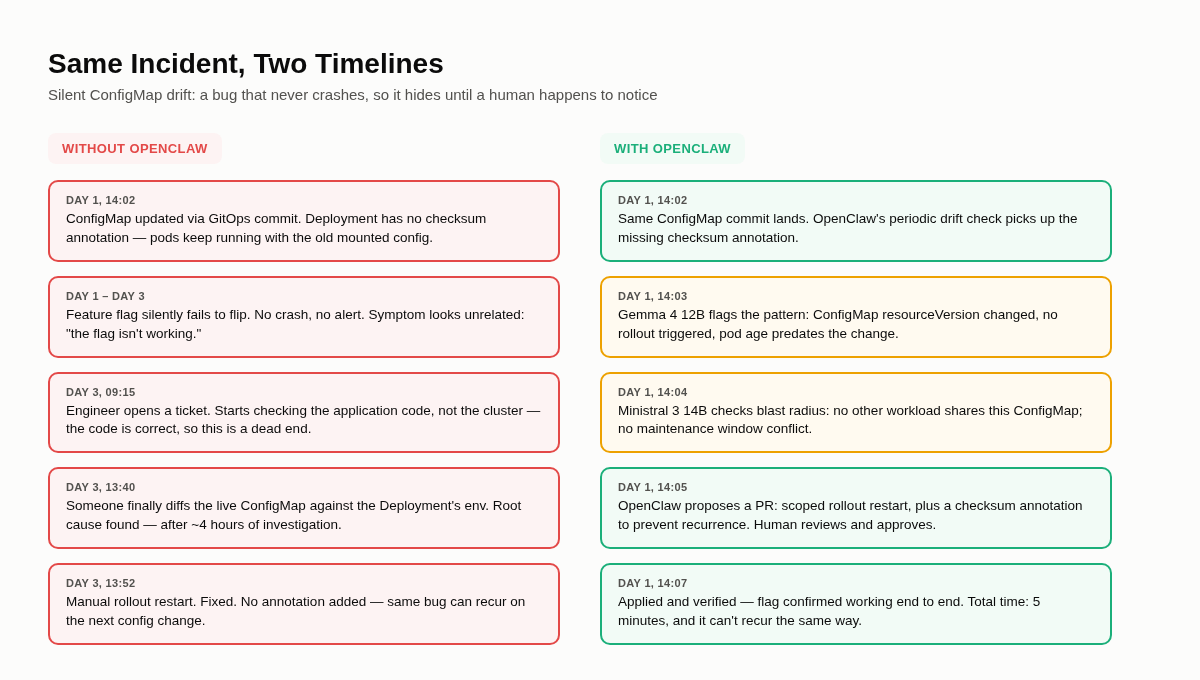
Take a common but annoying class of bug: a ConfigMap changes, but the Deployment referencing it via envFrom doesn't restart, so pods keep running against stale configuration. Nothing crashes — which is exactly why it's hard to catch. Symptoms show up sideways: a feature flag that won't flip, a timeout value that won't take effect, a cache TTL nobody can explain.
In a manual investigation, an engineer has to notice the symptom, suspect config staleness, diff the live ConfigMap against the Deployment's expected environment, and manually restart the right workload. It's a five-minute fix once you know where to look, and a multi-hour investigation before that.
With Gemma 4 12B reading the ConfigMap history and Deployment spec together, this pattern is recognizable almost immediately: the ConfigMap's resourceVersion changed three commits ago, but the Deployment has no checksum annotation forcing a rollout, and pod age predates the ConfigMap change. Ministral 3 14B's long context pass confirms no other workload depends on the same ConfigMap in a way that would make a rolling restart risky, and checks whether a maintenance window is already scheduled that could absorb the restart. OpenClaw then proposes the smallest safe intervention a scoped rollout restart, or a checksum annotation patch to prevent recurrence and waits for approval.
The value isn't that the AI "fixed Kubernetes." It's that the five minute fix stopped costing the multi-hour investigation.
What this does not replace
It's worth being direct about the boundaries, because overclaiming here erodes trust faster than it builds it:
- It doesn't replace GitOps as the source of truth. Every change OpenClaw proposes should still land as a diff against your Git-managed manifests, not a silent live cluster edit that drifts from what ArgoCD or Flux thinks is deployed.
- It doesn't replace runbooks it reads them. The models perform best when they're grounded in your team's existing incident documentation, not inventing procedure from general training data.
- It doesn't replace judgment on irreversible actions. Anything destructive deleting a PVC, force pushing a Git branch, dropping a database table stays behind an explicit human approval gate, full stop.
- It doesn't remove the need for regression checks. A remediation is not "done" because a pod is Ready; it's done when the functional workflow the alert was protecting is confirmed working end to end.
The honest way to describe this stack is: it compresses the distance between "something is wrong" and "here is a reviewable, evidence-backed fix," without removing the human from the decision to apply it.
Why local models, specifically
There's a recurring question from k8s teams evaluating this kind of tooling: why not just point OpenClaw at a hosted frontier API and skip the GPU node entirely? Three reasons show up repeatedly in practice:
- Data gravity. Cluster diagnostics routinely include things you don't want leaving your network: internal hostnames, secret names (even redacted, the existence and naming pattern leaks information), and traffic shapes that reveal business logic.
- Latency and availability. An incident is the worst possible moment to discover your remediation pipeline depends on an external API having a good day. A model running on cluster hardware has no egress dependency to fail.
- Cost at incident volume. Diagnostic loops are chatty — multiple calls per incident, run across a whole fleet of clusters. Amortized against owned GPU hardware, that volume is far cheaper than metered hosted inference, especially once you're running this pattern across dozens of namespaces continuously rather than only during declared incidents.
None of this is an argument against frontier hosted models generally — they remain the right tool for open ended reasoning where data sensitivity and latency aren't binding constraints. It's an argument for matching model deployment to the operational shape of the problem, and cluster operations has a shape that favors local, right-sized models wired into a disciplined action layer.
How ITSulu runs this today
ITSulu's own control plane, a small, real, multi vendor Kubernetes cluster rather than a single cloud reference architecture — runs this pattern in practice: Gemma 4 12B and Ministral 3 14B on GPU backed worker capacity, OpenClaw as the agentic layer with scoped tool access, and every proposed change flowing back through Git before it's considered real. It's the same completion standard we hold ourselves to internally: no task is "done" on a green health check alone — GitOps state, runtime state, dependencies, the actual functional workflow, logs, and regression checks all have to line up before we call an incident closed.
If you're running Kubernetes and evaluating whether agentic operations tooling is worth the investment, the questions worth asking a vendor including us are the same ones this post tried to answer honestly: What data leaves your network? What's the blast radius of an autonomous action? And what happens when the model is wrong?
ITSulu Kubernetes and OpenClaw services are built around answering those three questions before we answer "how fast can it fix things." If your team wants to see the stack running against a real workload rather than a slide, reach out we'd rather show you the cluster than the pitch.