Anthropic's Claude Fable 5 has become a useful reminder that frontier AI news does not stop at the announcement stage. On June 9, 2026, Anthropic announced Claude Fable 5. On June 12, 2026, the company posted an update that access to Claude Fable 5 and Claude Mythos 5 was unavailable. Anthropic's status history shows the suspension landing on June 13 at 00:50 UTC, and the product page still says the model is unavailable as of June 15. AP also reported on June 13 that Anthropic had taken its latest models offline to comply with a government directive. Those are the verified facts that matter right now.
For the general public, that sequence is more important than any hype cycle. It tells you two things at once: the model was released with significant attention, and the release was quickly followed by a safety and access decision that changed what people could actually use. If you are not a technical buyer, the practical lesson is still straightforward. In frontier AI, what was announced last week is not always what is available today. A company's status page matters more than a rumor, and a product's real-world accessibility matters more than a screenshot of a demo.
For businesses, the story becomes even more interesting. Claude Fable 5 is being discussed as a major model family release with strong reasoning and agentic capability. Anthropic's launch materials position it as the latest step in the company's model roadmap, while the follow-up notice makes clear that capability and access are separate problems. That separation is what every AI program needs to understand. You can have a powerful model and still have to pause, route, restrict, or retire access based on policy, compliance, or safety concerns.
1. What the official updates say
Anthropic's June 9 announcement frames Claude Fable 5 as a major new release for demanding work. The company describes it as a Mythos-class model made safe for general use and positions it for ambitious tasks that take longer than a single prompt. Then, only a few days later, Anthropic says access to Claude Fable 5 and Claude Mythos 5 is unavailable. That later update is not a side note. It is the current operating status of the product.
Anthropic's own news and status pages are consistent with each other. The news post carries both the launch and the access-unavailable update. The Claude status history also records the suspension. AP's reporting on June 13 adds a separate reputable source that confirms the company took the models offline in response to a government directive. When those sources agree, the safest conclusion is not speculation. It is simply that Fable 5 is currently unavailable and that the launch cycle moved quickly into a pause.
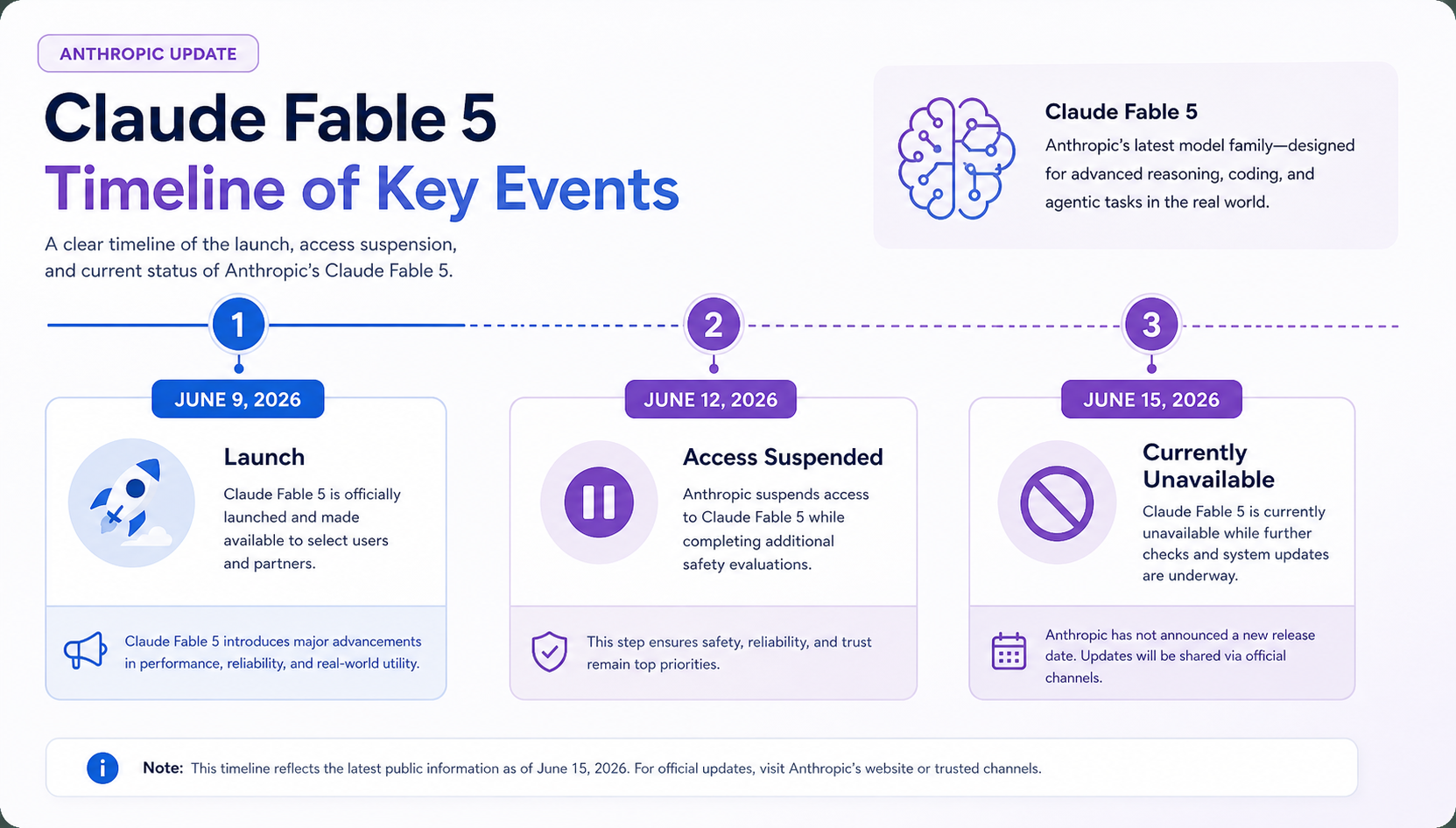
That timeline is the reason this post matters. If you are following AI news casually, it is easy to remember the launch and forget the pause. If you are trying to make a business decision, the pause is the headline. The product's current state determines whether it is available for adoption now or whether you need to plan around something else.
2. Why the pause matters for ordinary users
Most people do not need a lab-grade understanding of frontier AI policy. They do need to know how to interpret a product that appears, disappears, and changes status within days. That pattern is common in rapidly advancing AI systems. Models arrive with capability claims, then encounter safety, compliance, or operational controls that can affect access. Claude Fable 5 is a clear example.
For ordinary users, the useful mental model is simple. Think of AI products as services with changing conditions, not as static appliances. A model can be strong and still be temporarily unavailable. A company can be confident about a launch and still need to restrict access shortly afterward. If you are choosing tools for work, the right habit is to check the current product page, the status page, and the release notes before you commit time or money.
That habit protects you from overpromising and underdelivering. It also helps you avoid building a workflow around a tool that may not be available tomorrow. The businesses that stay calm in this environment are the ones that plan for continuity instead of depending on one model name alone.
3. What businesses should actually ask
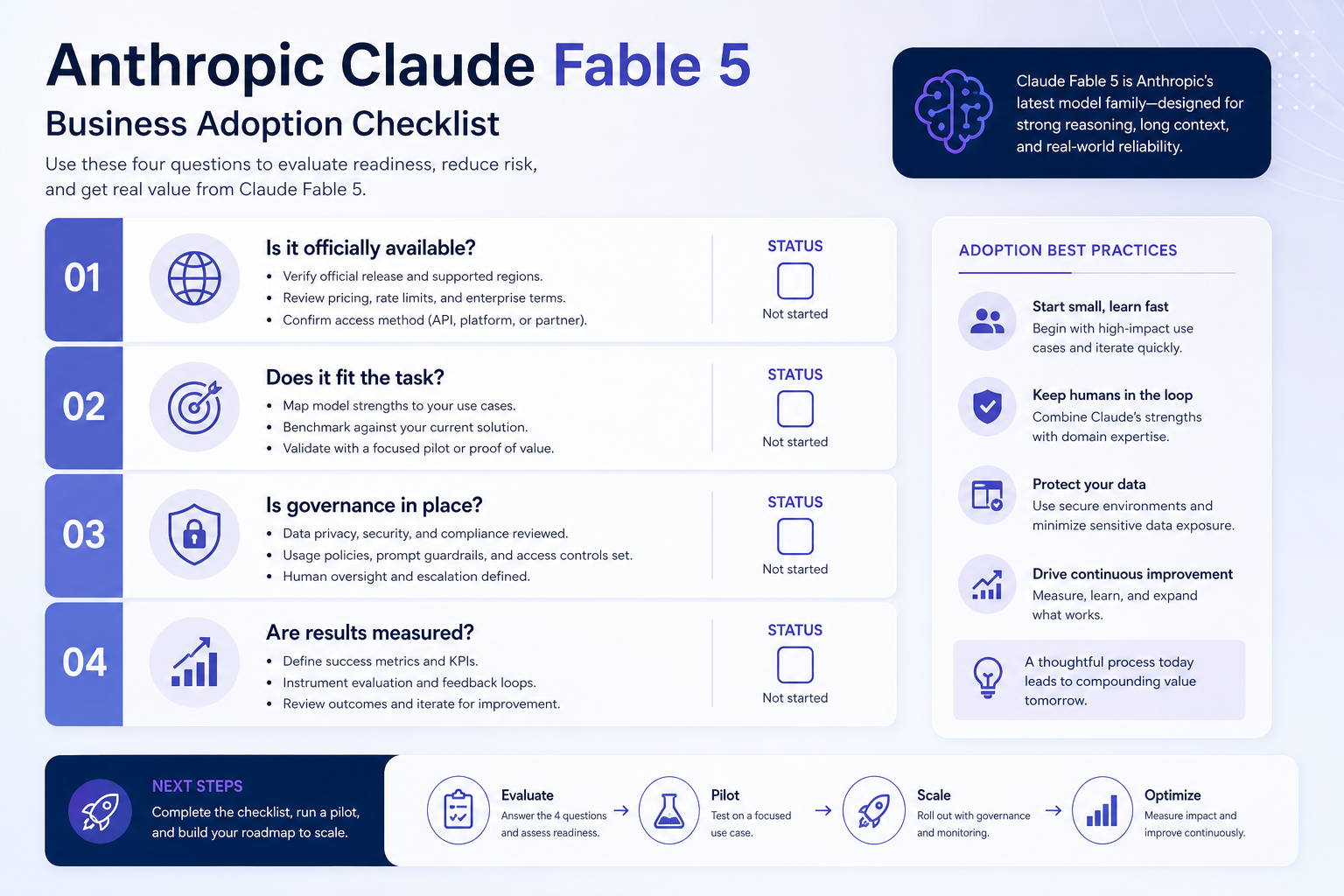
Whenever a new AI model gets attention, companies tend to ask the wrong first question. They ask whether the model is the smartest or fastest. That is not wrong, but it is incomplete. The more useful questions are whether the model is available, whether it fits the task, and whether the organization has governance around it.
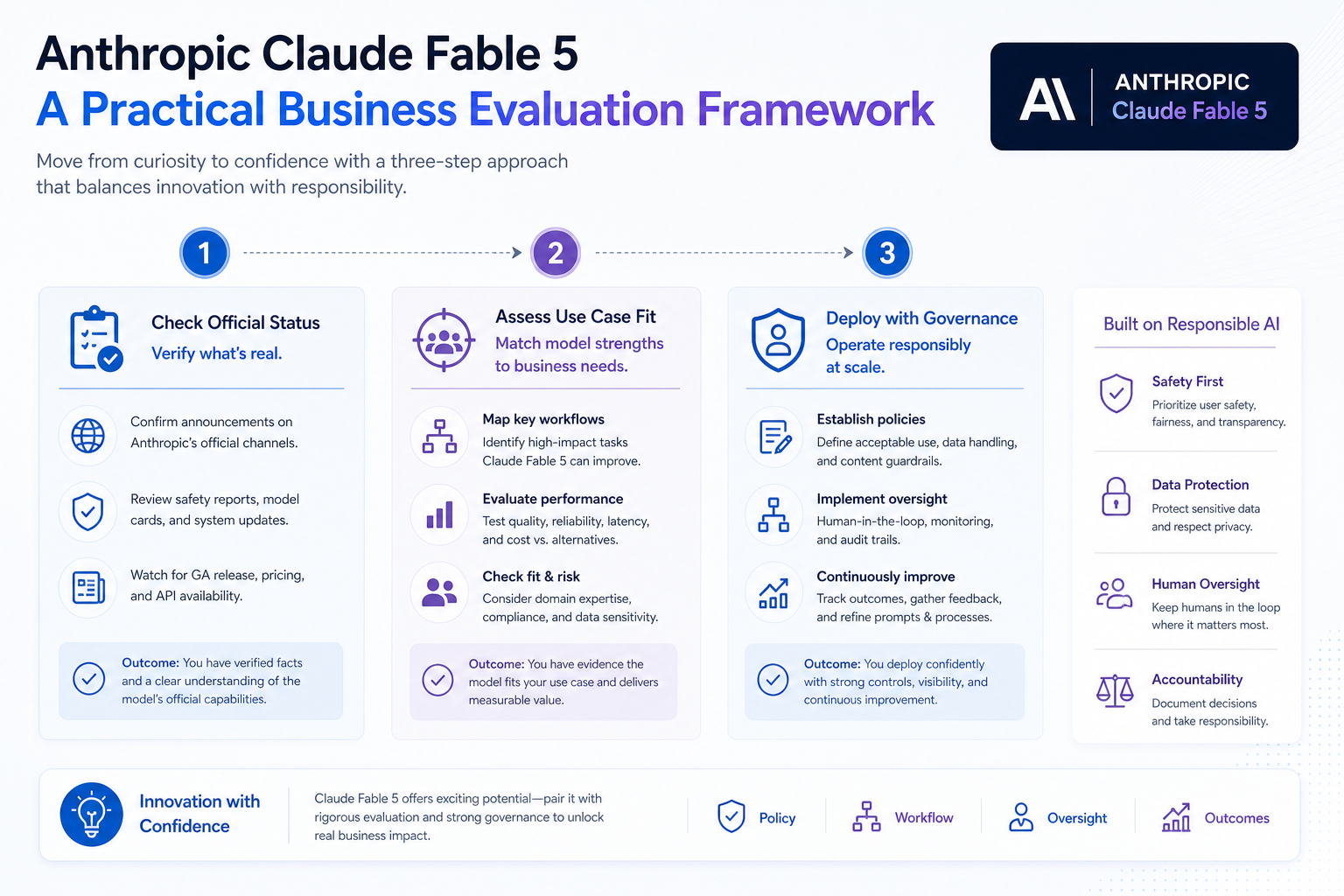
Availability is obvious in the Claude Fable 5 case because Anthropic's own materials currently say the model is unavailable. Fit matters because even a powerful model may not be the right answer for every workflow. A customer-support use case, a content workflow, a coding workflow, and a legal drafting workflow all have different risk profiles. Governance matters because AI can create operational risk if no one has defined how prompts are reviewed, how outputs are verified, where logs are stored, or what happens when a model becomes unavailable.
This is where many teams get stuck. They chase a model launch before they have built the surrounding system. Then the launch changes, the access changes, and the team has no fallback. That is expensive. The better pattern is to design around the workflow first and the model second.
At ITSulu, this is the kind of work we spend a lot of time on. The value is not in grabbing the newest model as soon as it appears. The value is in building a real operating model that still works when the tools shift under you. That means use-case mapping, fallback logic, access control, and a review process that keeps a human in charge of important decisions.
4. What Anthropic's approach suggests about frontier AI
Claude Fable 5 is more than a product name. It is a case study in how frontier AI companies are balancing capability and policy. Anthropic says Fable 5 is a Mythos-class model made safe for general use, and it also says that certain sensitive queries are routed differently. That is a sign that the company is not treating all use cases as equal. Instead, it is dividing the model surface into categories that can be governed differently.
That is likely to become more common across the AI industry. As systems get more capable, companies will have to be more precise about what the model can do, what it should not do, and what controls apply in which contexts. Users may experience this as friction. Businesses should experience it as maturity. The point is not to remove risk by pretending it does not exist. The point is to manage it with transparent rules.
For the public, this is a useful reminder that good AI is not only about outputs. It is also about process. A model that is easy to use but hard to govern can become a liability very quickly. A model that is slightly less flashy but much easier to control may be the better business choice.
5. The latest news, in plain language
Here is the short version. Anthropic launched Claude Fable 5 on June 9. Anthropic then suspended access on June 12. Anthropic's status history shows the suspension on June 13 UTC. The product page still shows unavailable as of June 15. AP reported on June 13 that Anthropic had taken its latest models offline to comply with a government directive. The verified picture is therefore not ambiguous: Fable 5 is real, the launch was recent, and the current availability is paused.
If you are reading AI news to stay informed, that is the key update. If you are reading it to make decisions, the question becomes what you do next. The answer should not be to wait for the buzz to settle. The answer should be to put a workflow in place that can adapt to whatever model is available and appropriate at the time.
That is exactly the kind of decision-making ITSulu supports. We help teams turn fast-moving AI news into concrete plans: which use cases to pilot, what controls to put in place, which systems to integrate, and how to keep the business moving if a model changes status. The news matters, but the operating model matters more.
6. What to watch next
The next relevant update will probably come from Anthropic's own product pages or status history. If access is restored, Anthropic will likely say so there first. If the company changes the product surface again, the same source should be the first place to check. For businesses, the safest practice is to monitor the official pages rather than rely on old social posts or stale summaries.
That is not just a Claude Fable 5 lesson. It is an AI lesson. The pace of change means that status, policy, and access are part of the product. Serious teams build around that reality instead of pretending it will go away. The upside is that once you accept that reality, you can make much better decisions about where AI adds value and where it still needs restraint.
Claude Fable 5 may eventually become a more stable option again. When that happens, businesses that have already built governance and fallback thinking will be ready to use it well. Businesses that skipped that work will be starting from scratch.
How ITSulu Can Help
ITSulu helps organizations translate fast-moving AI news into practical action. That includes workflow design, automation, governance, content systems, and implementation support that keeps humans in control. If you want to evaluate Claude Fable 5 or any similar frontier model without getting trapped in hype, ITSulu can help you build the decision path first and the tooling second.